Back to News Page

Why the Next Decade Belongs to the Landlords

November 11, 2025

By: Travis Watts, Director of Investor Development

 

How Multifamily Investors Are Quietly Reshaping the Wealth Landscape

For decades, wealth creation in America has taken many forms.
In the 1980s, it was stockbrokers. In the 1990s, it was dot-com founders. The 2010s brought Silicon Valley and digital disruption to the forefront. But looking ahead, a more time-tested, resilient strategy may take the lead:

Multifamily real estate ownership.

Not the traditional, hands-on landlord model, but fractional ownership in professionally managed multifamily assets designed to generate passive income and preserve capital over time.

For investors seeking real estate exposure, cash flow, and long-term growth potential, this may be the defining opportunity of the next decade.

The Macro Shift: Why Real Assets Matter More Than Ever

Several structural trends continue to support the multifamily sector, even amid changing market dynamics:

  • A Persistent Housing Gap: The U.S. still faces a significant housing shortfall, particularly in the more affordable sector of high-growth metros, where population and job growth continue to outpace new construction.
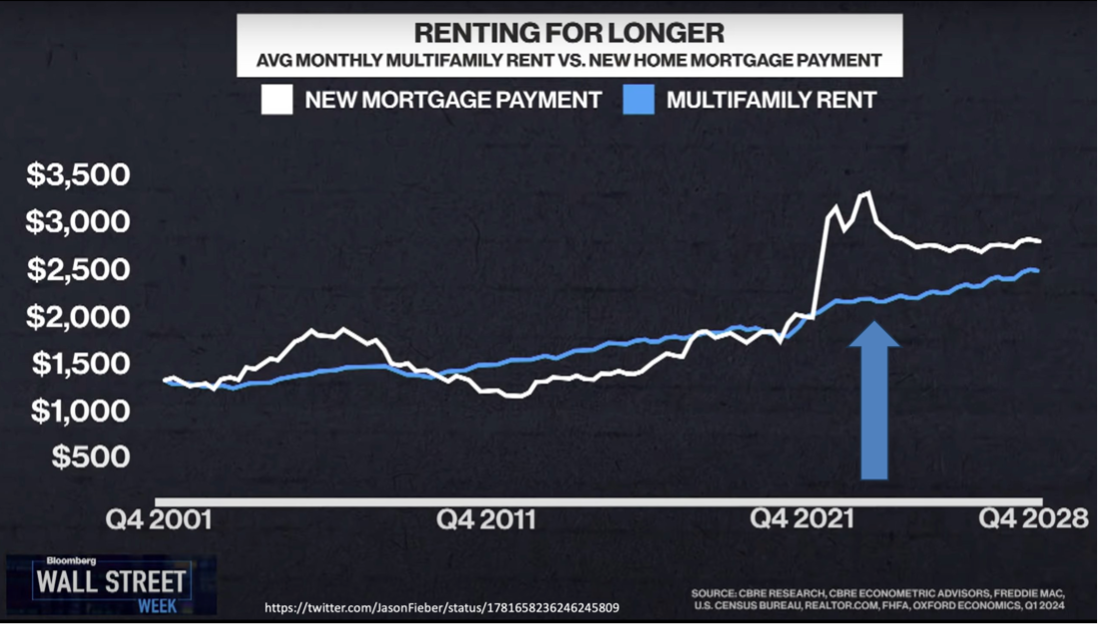
  • Lifestyle-Driven Renting: Many households are choosing to rent longer due to flexibility, affordability constraints, and preference.
  • Stock Market Volatility: Recent stock volatility has prompted many investors to seek lower-volatility alternatives with potential for passive income.
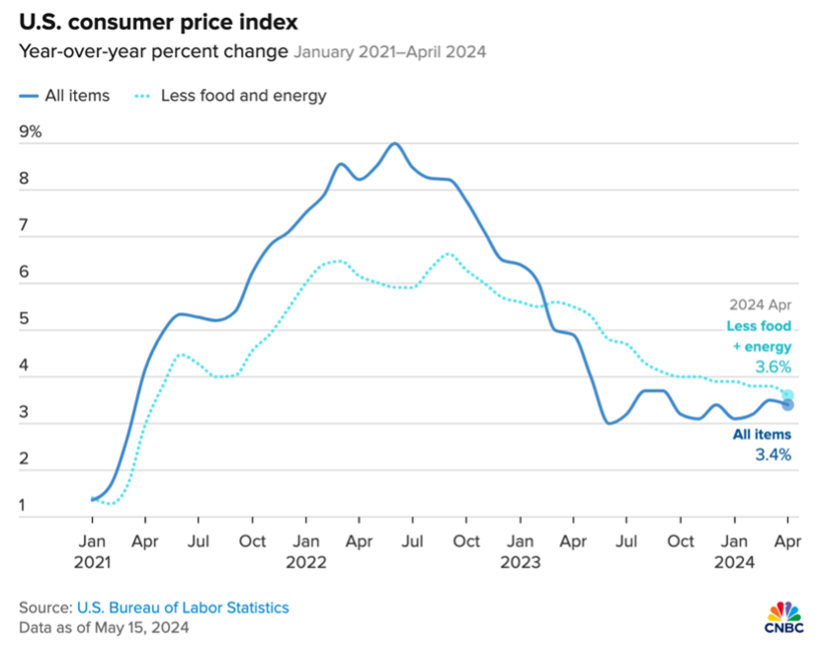
  • Inflation Considerations: Historically, real estate has demonstrated the potential to provide a degree of inflation protection due to rent adjustments and the continued high costs of building new product.
  • Declining Rate Environment: The Fed recently began reducing rates, which is bullish for real estate valuations. Lower rates provide buyers more affordability when financing.

We anticipate these trends to continue benefiting well-positioned multifamily assets, and the investors aligned with them.

Reframing Returns: From Growth to Income

Today’s investors aren’t just seeking growth, they’re seeking income in a declining rate environment.

Multifamily investing can offer the potential for both targeted monthly income and targeted appreciation over time. But unlike more volatile asset classes, real estate’s value lies in its foundational utility: people will always need a place to live.

At Ashcroft Capital, we offer two main types of investment opportunities, each built to meet different investor goals.

For those focused on income, the Ashcroft Income Note offers scheduled monthly payments, making it a strong option for cash flow investors.

For those interested in long-term growth, equity investments like Halston Waterleigh provide ownership in multifamily assets with the potential for appreciation and modest ongoing distributions.

Across all offerings, our goal is consistent: To help investors preserve capital, generate cash flow, and build long-term value.

* This material is neither an offer to buy or sell securities or a solicitation of such offers.

Institutional Demand Meets Individual Access

Institutional interest in multifamily real estate has increased significantly over the past decade, driven by a healthy risk/reward profile and historically strong performance.

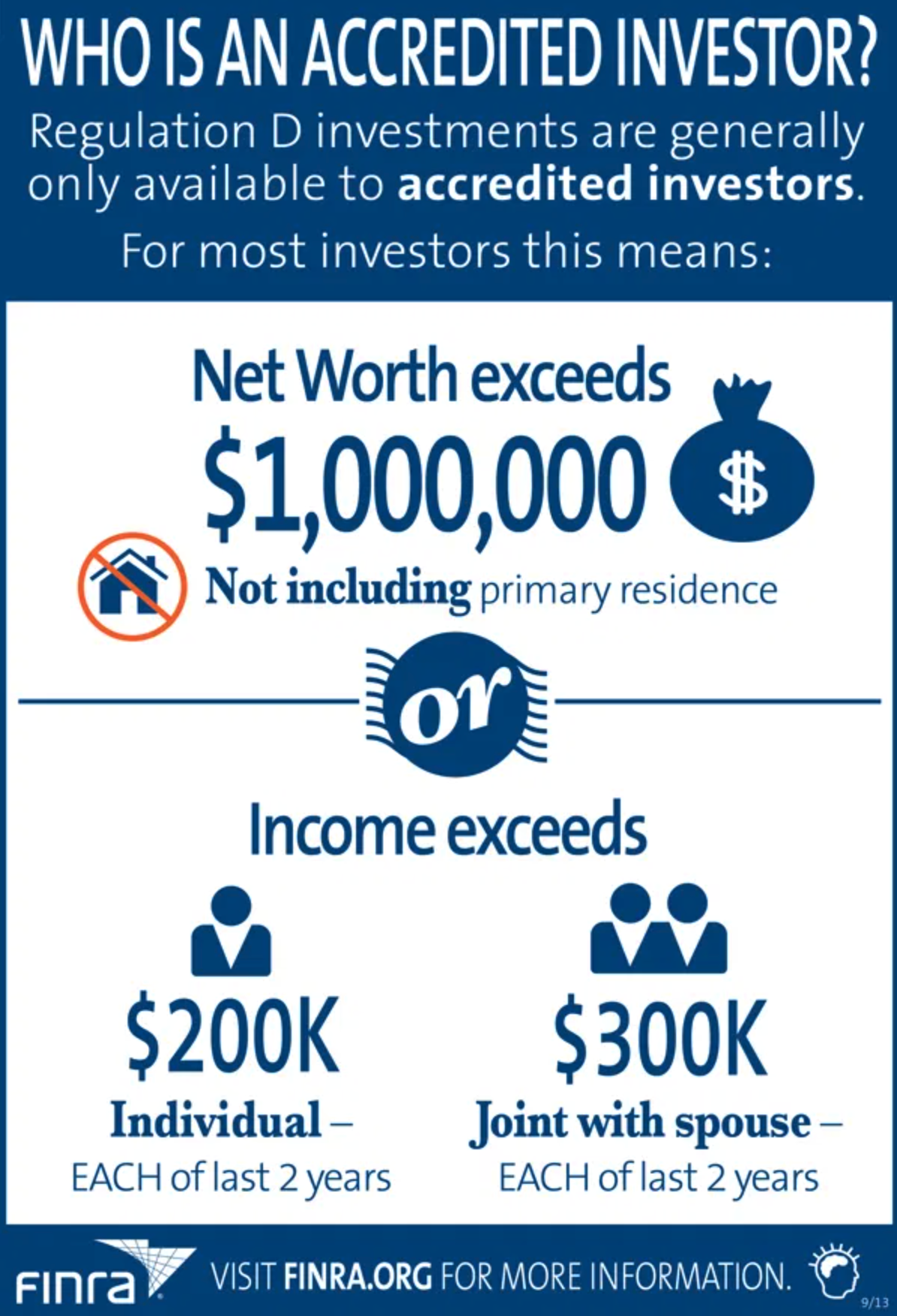
But this isn’t just a story for pension funds or large private equity groups. Through Ashcroft’s platform, individual accredited investors can gain access to institutional-quality multifamily assets that are professionally managed, strategically selected, and built for Limited Partner participation.

This model allows our investors to participate in real estate ownership without the operational burdens of property management.

Passive Real Estate Ownership—Not Landlording

Owning multifamily real estate through a private placement offering isn’t the same as being a landlord. Investors aren’t managing properties, screening tenants, or handling maintenance request

Instead, they’re participating in a professionally operated investment vehicle targeting:

  • Monthly cash flow
  • Long-term capital preservation
  • Potential tax advantages
  • Diversification from publicly traded investments

In short, this is real estate investing built for simplicity and scale; aligned with the needs of today’s accredited investors.

Positioned for 2025 and Beyond

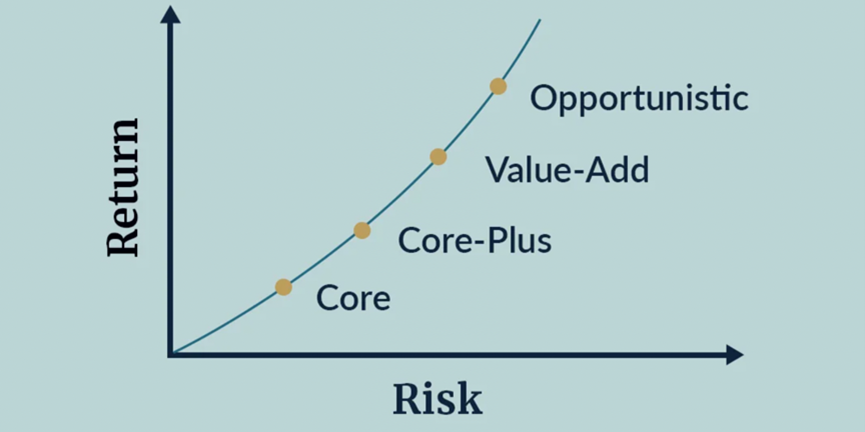
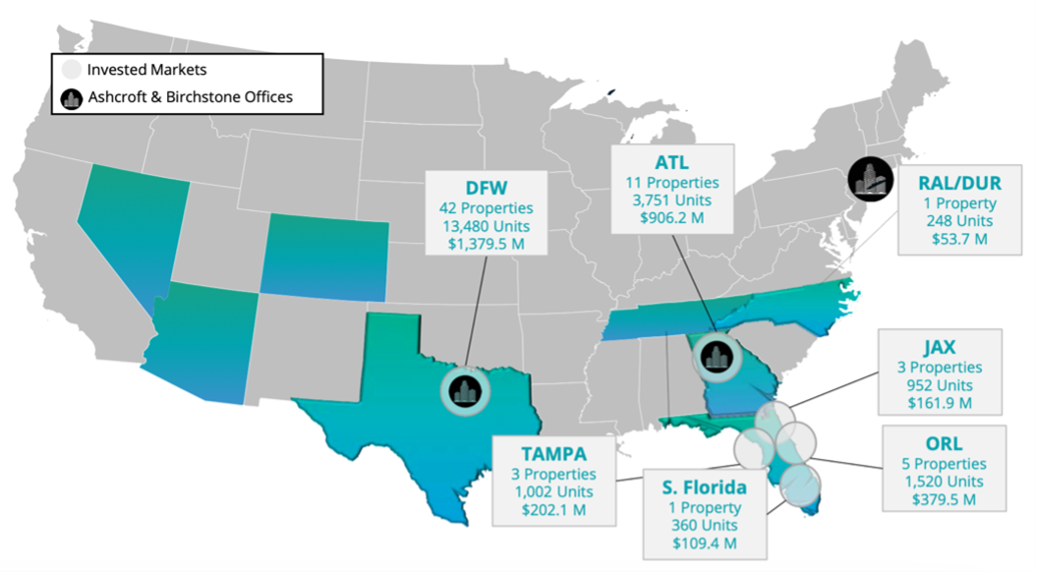
Ashcroft Capital continues to focus on core-plus, core and value-add multifamily investments in high-growth markets. Our in-house team handles acquisitions, construction management, and operations with a focus on cost efficiency and investor experience.

In an environment where many firms are taking a wait-and-see approach, we’re committed to active sourcing, disciplined underwriting, and creating opportunities for our investor community.

We believe long-term success in real estate isn’t about speculation; it’s about strategy, streamlined operations, and execution.

Past performance is not necessarily indicative as future results.

Final Thought: Think Like an Owner

The next decade may not belong to the loudest markets, but rather the most resilient ones.

For investors re-evaluating their portfolio in today’s environment, multifamily real estate limited partnerships offer a compelling balance of income potential, downside protection, and long-term alignment with real-world demand. We welcome you to join us for a property tour in Orlando this November or December. Please email investors@ashcroftcapital.com to learn more.

Are you investing for headlines—or for outcomes?

Ashcroft Capital exists to help investors like you think like owners, without taking on the day-to-day hassle of ownership. If you’re ready to explore that difference, we’re here to help.


Connect with our team to explore current opportunities or learn more about our investment thesis for 2025 and beyond.

——-

Explore our Current Offerings


Disclaimer: This material is for informational purposes only and is not intended as an offer to buy or sell securities or a solicitation of such offers to purchase securities. Any such offer will be made only through official offering documents and only to verified accredited investors as defined by Regulation D, Rule 506(c) of the Securities Act of 1933.

This content may contain forward-looking statements, including references to potential regulatory developments and future access to private real estate investments through retirement accounts. These statements are subject to risks and uncertainties, and actual outcomes may differ materially.

Past performance is not indicative of future results. All investments carry risk, including the potential loss of principal. Investors should consult their financial and legal advisors before making any investment decision. Ashcroft Capital does not provide tax, legal, or investment advice. Any discussion of potential tax-advantaged strategies is for illustrative purposes only and may not be available to all investors. This material does not constitute an offer to buy or sell securities or a solicitation of such offers.

Back to News Page

What the Silent Supply Crisis Means for Apartment Investors in 2025

October 27, 2025

By: Travis Watts, Director of Investor Development

 

The Case for Optimism in Multifamily 

The U.S. multifamily market is entering a pivotal period. While attention remains fixated on interest rates and inflation, a deeper structural imbalance is emerging: one that could define multifamily investment performance over the next decade. The core issue: supply is quietly falling behind demand. For investors today, this presents an opportunity hiding in plain sight.

The Understated Imbalance

Recent headlines have focused on multifamily deliveries peaking in select markets. On the surface, it would appear the sector is headed for oversupply. However, a closer analysis reveals the opposite.

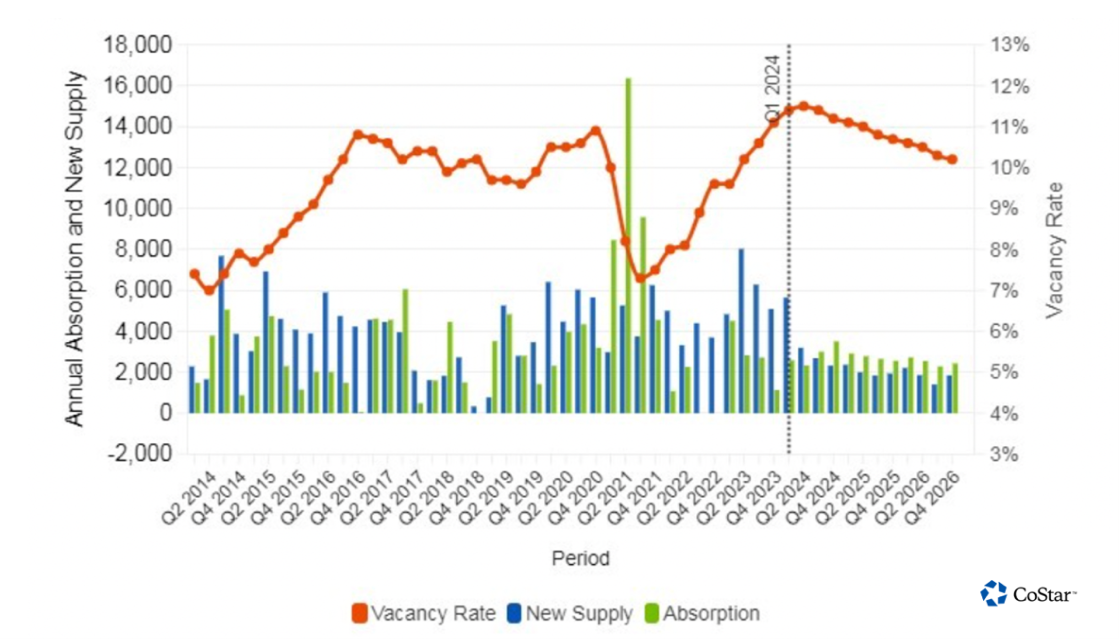
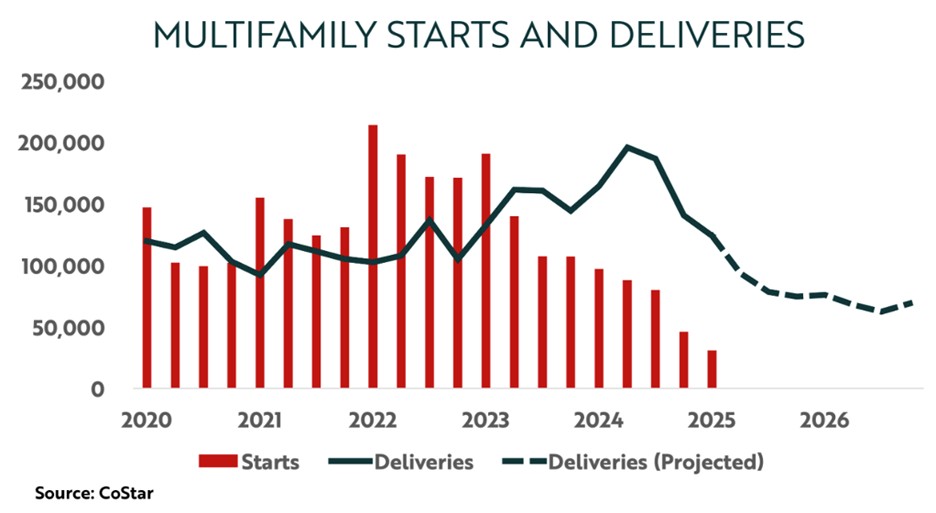
Starts for new multifamily construction have declined by more than 30% year-over-year as of Q2 2025, according to CoStar’s analysis of Census Bureau data. Rising construction costs, restrictive zoning laws, tightening credit markets, and long permitting timelines have created a bottleneck in the new supply pipeline. What we’re witnessing is not a glut, but a short-term delivery surge masking a longer-term drought. This isn’t a bubble about to burst; it’s a well running dry.

In effect, the U.S. is building fewer apartments, at precisely the time demographic and migration patterns are driving up demand.

Source: https://www.graycapitalllc.com/report-the-multifamily-window-why-2025-could-be-the-best-buy-opportunity-in-years/

Demographics Don’t Wait

Demand fundamentals remain robust. Millennial and Gen Z households are forming at a faster clip, and affordability constraints in the single-family market are locking more Americans into rental living for longer periods.

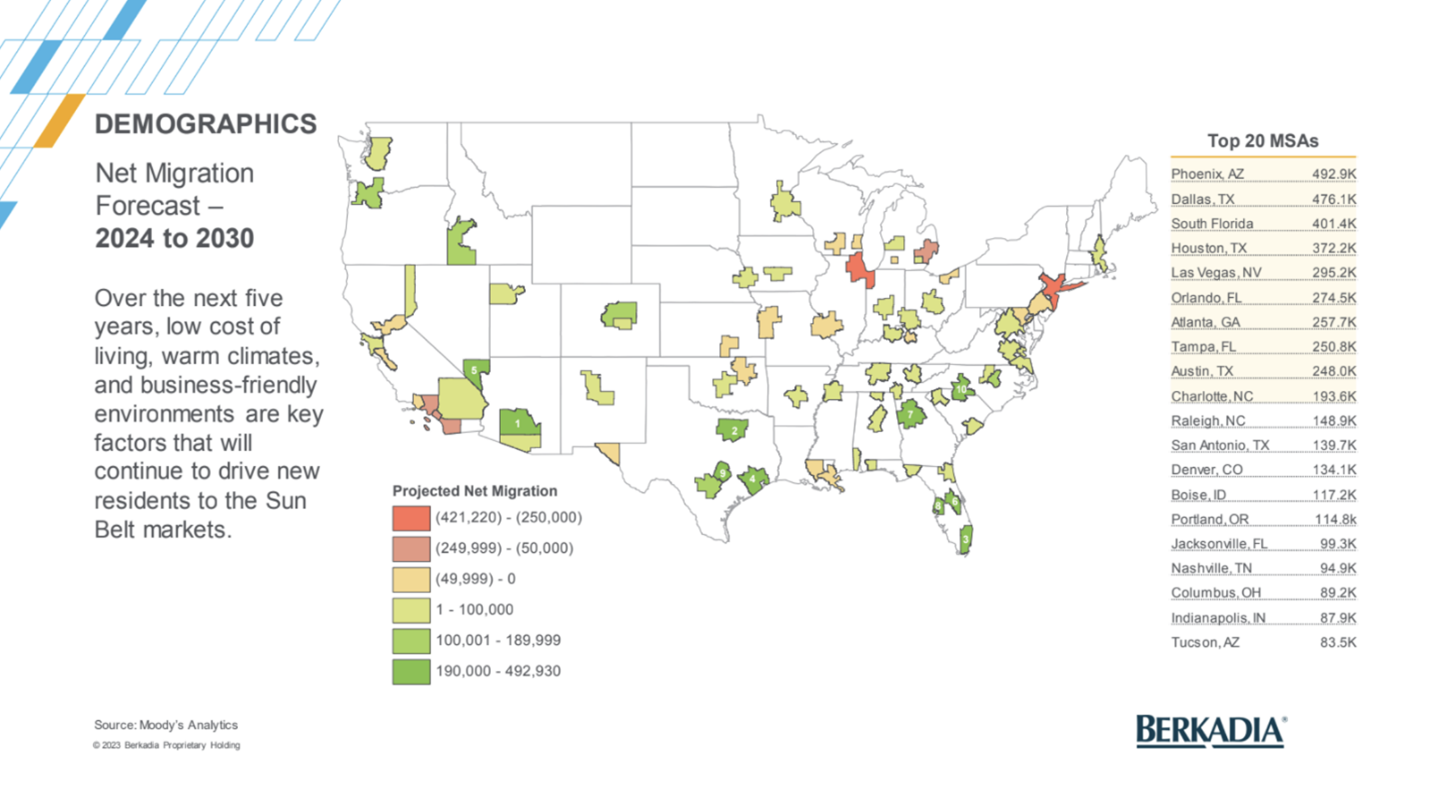
Meanwhile, migration to the Sunbelt—where Ashcroft’s portfolio is concentrated – continues to outpace national averages. States like Texas, Florida, Georgia, and North Carolina are absorbing outsized population inflows, with workforce renters leading the charge.

When supply slows and demand persists, the implication is clear: rent growth pressure builds over time.

Why This Matters for Investors

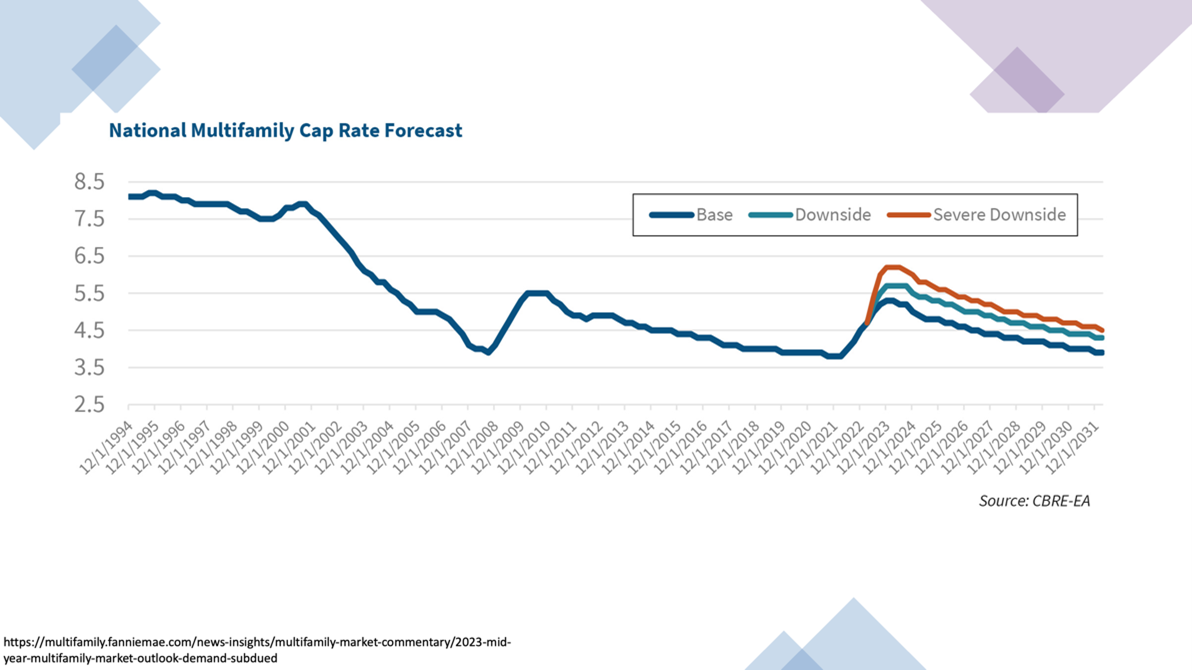
Multifamily has long been a favored asset class for its relative stability and growth potential. But today, we have an environment where cap rates have already expanded, and transaction volumes are beginning to increase, selectivity and operational edge matter more than ever.

The silent supply crisis amplifies the importance of:

  • Buying Right: Access to off-market or favorably priced assets is essential as opportunities become more competitive.
  • Operating Efficiently: Creating value through operational improvements and cost savings can drive investor returns more than simple rate improvement.
  • Holding Long-Term: Investors positioned to ride out rate volatility may benefit from compressed supply and strengthening rent fundamentals in the years ahead.

Ashcroft’s Strategic Response

At Ashcroft, we see this imbalance not as a risk to be avoided, but as an opportunity to be earned. We are actively acquiring in targeted markets where the supply/demand imbalance is most acute. Our vertically integrated model spans from acquisitions, asset management, renovations, warehousing bulk materials and operating property management in-house. This enables us to underwrite and execute with discipline and scale.

Recent acquisitions, such as Halston Waterleigh, reflect our focus on resilient submarkets with constrained future supply and strong in-place demand. Our value-add approach is designed to improve resident experience, drive retention, and enhance the upside on our properties, without relying on market trends to become more favorable.

Conclusion: Quiet Crises Create Quiet Opportunities

While much of the market remains preoccupied with rate policy, the deeper story is unfolding in the fundamentals. The underbuilding of multifamily stock is not an immediate headline, but it is a slow-moving force that can shape returns for years to come.

For investors seeking long-term growth, inflation protection, and demographic tailwinds, multifamily remains a compelling opportunity, especially for those aligned with experienced operators who are already positioned for what’s next. Every real estate cycle creates volatility and distraction, but the long-term investor looks for a quiet signal underneath. Today, that signal is supply.

Interested in how today’s market could impact your portfolio?

Why This Matters for Investors

Multifamily has long been a favored asset class for its relative stability and growth potential. But today, we have an environment where cap rates have already expanded, and transaction volumes are beginning to increase, selectivity and operational edge matter more than ever.


Connect with our team to explore current opportunities or learn more about our investment thesis for 2025 and beyond.

——-

Explore our Current Offerings


Disclaimer: This material is for informational purposes only and is not intended as an offer to buy or sell securities or a solicitation of such offers to purchase securities. Any such offer will be made only through official offering documents and only to verified accredited investors as defined by Regulation D, Rule 506(c) of the Securities Act of 1933.

This content may contain forward-looking statements, including references to potential regulatory developments and future access to private real estate investments through retirement accounts. These statements are subject to risks and uncertainties, and actual outcomes may differ materially.

Past performance is not indicative of future results. All investments carry risk, including the potential loss of principal. Investors should consult their financial and legal advisors before making any investment decision. Ashcroft Capital does not provide tax, legal, or investment advice. Any discussion of potential tax-advantaged strategies is for illustrative purposes only and may not be available to all investors. This material does not constitute an offer to buy or sell securities or a solicitation of such offers.

Back to News Page

Q4 2025 Ashcroft Insights Market Report

October 8, 2025

Q4 2025 Market Report


As we enter Q4 of 2025, the U.S. multifamily sector is at a strategic turning point. A September interest rate cut by the Federal Reserve signaled a continued shift in monetary policy. While supply pressures persist in certain metros, demand fundamentals remain sound. Rent growth has moderated, but occupancy rates continue to hover near equilibrium in many markets. Transaction volumes are increasing, and cap rates appear to be peaking, and in many metros, have already begun to decline.

In case you missed it: We recently hosted a webinar with John Chang  from Marcus & Millichap, where John discussed how macroeconomic headwinds are impacting investor sentiment—and what that means for multifamily positioning in Q4 and beyond. Check out the replay HERE.


Key areas of focus include: 

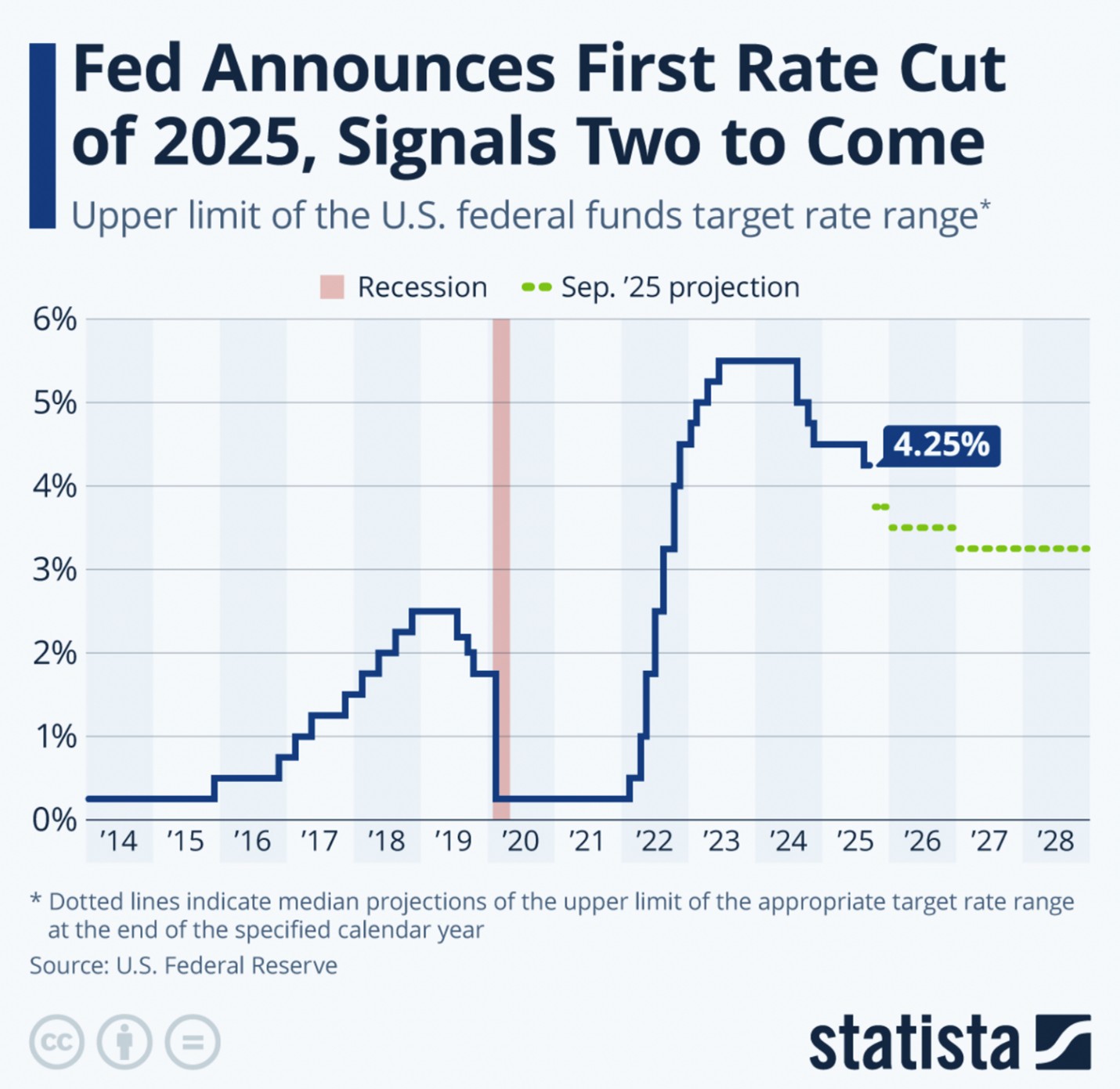
  • The Fed cut rates by 25 bps (0.25%) in September, sparking optimism and setting the stage for renewed activity.
  • Rent growth is subdued, but demand is holding steady; oversupplied markets face short-term softness, while others remain resilient.
  • Construction starts are falling rapidly, laying the groundwork for improved fundamentals in 2026.
  • Multifamily continues to outperform riskier asset classes and remains an attractive hedge against economic uncertainty.

Multifamily Fundamentals Snapshot


Source:
https://bdi-insurance.com/commercial-specialties/apartment-owners/


  • Over 116,000 units were absorbed in Q2 2025, continuing one of the strongest years on record. (Cushman & Wakefield)
  • Renters continue to delay homeownership due to high interest rates and home prices, bolstering demand for apartments.

Rent Growth & Vacancy:

  • National average apartment rent as of September 2025 is $1,750, reflecting +0.6% YoY (Yardi Matrix)
  • Some oversupplied metros have experienced rent declines; however, the national occupancy rate remains stable (~94.7%), unchanged year-over-year. (Yardi Matrix)

Key Trend: Resilient demand is being tested by elevated supply. We anticipate equilibrium returning as deliveries taper in 2026.

September Fed Cut: A Subtle But Strong Signal


Source: https://www.statista.com/chart/21023/us-federal-funds-target-rate/?srsltid=AfmBOoqR1MJFa26HtzRA5KdYAE8mwh39dIQo42EHbCjxeP9tM-fD2c3z


The Move:

  • The Fed reduced its target rate to 4.00% – 4.25% in September 2025.
  • Rationale: Softer labor data, improved inflation trends, and increased global risk factors. (Source: Federal Reserve)

Why It Matters:

  • Lower Cost of Capital: Reduced borrowing costs improve feasibility of acquisitions, refinances, and recapitalizations.
  • Market Psychology: Even modest cuts can boost confidence and reactivate capital markets.
  • Valuation Upside: With cap rates near peak, the path to compression may unlock value.
  • Tailwind for Multifamily: Compared to office, industrial, or retail, multifamily gains the most from financing tailwinds.

Construction Slowdown: Relief on the Horizon


Source: https://www.opportunitynowsv.org/blog/could-common-sense-be-the-answer-to-solving-californias-housing-crisis-the-answer-may-shock-you


  • The latest projections predict annualized starts will drop to approximately 372,000 units in Q4 2025, the lowest since 2017. (Source: Trinity Street)
  • Developers continue to face challenges from high material costs, stricter underwriting, and debt availability.
  • Supply pipelines are thinning, particularly in markets like Austin, Phoenix, and Orlando.
  • Investor Implication: These trends support a bullish long-term view on stabilized assets in constrained metros.

Valuation & Capital Markets


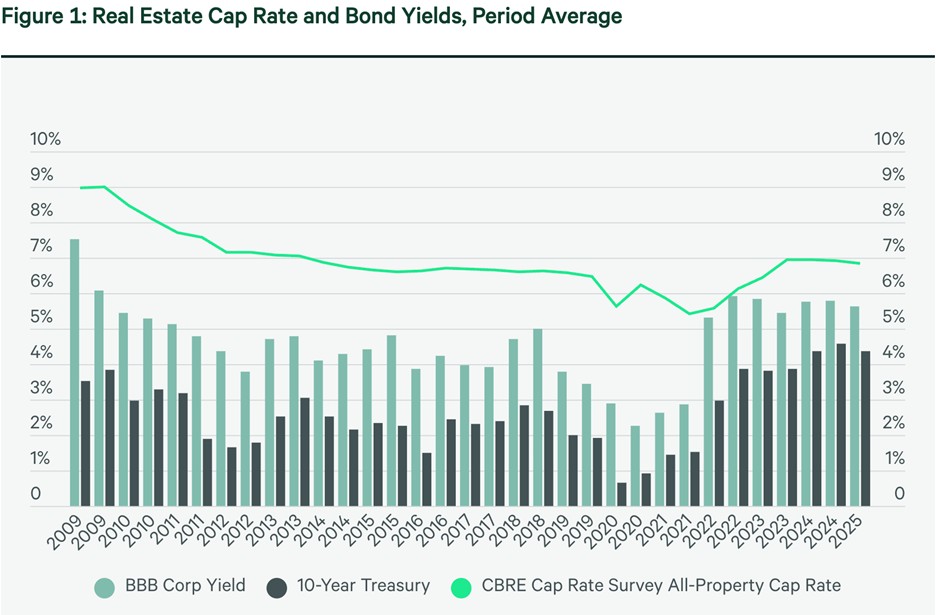
Source: https://www.cbre.com/insights/reports/us-cap-rate-survey-h1-2025


  • Cap Rates: CBRE’s H1 2025 survey reported modest ~9 bps compression, suggesting we may be at the cap rate peak. (Source: CBRE)
  • Spreads: The spread between multifamily cap rates and Treasuries remains tight, but may widen with more Fed easing.
  • Debt Market: Lenders remain selective. Financing is more widely available for stabilized deals with moderate leverage (55-65% LTV).

Ashcroft’s Strategic Positioning


Selectivity Over Scale:

  • We are focused on fewer acquisitions this year in markets with tighter supply pipelines and market tailwinds.

Value-Add Flexibility:

  • Our recent acquisitions offer optionality to improve and reposition as market conditions shift.

Cautiously Optimistic Underwriting:

  • Our pro forma assumptions include: modest rent growth and stabilized vacancy, coupled with a disciplined capex strategy.

Capital Flexibility:

  • Our capital stack strategies allow us to remain opportunistic as recap scenarios emerge and more buyers re-enter the sector.

Why Multifamily: Now More Than Ever


  • Construction Decline: Fewer starts today = tighter supply in the near future.
  • Lower Rates: With a 2024 and 2025 Fed cut already at play, and lower rates forecasted in 2026, today’s market signals a bullish turning point.
  • Cap Rate Compression Opportunity: Even 25-50 bps of future compression could materially lift investor returns.
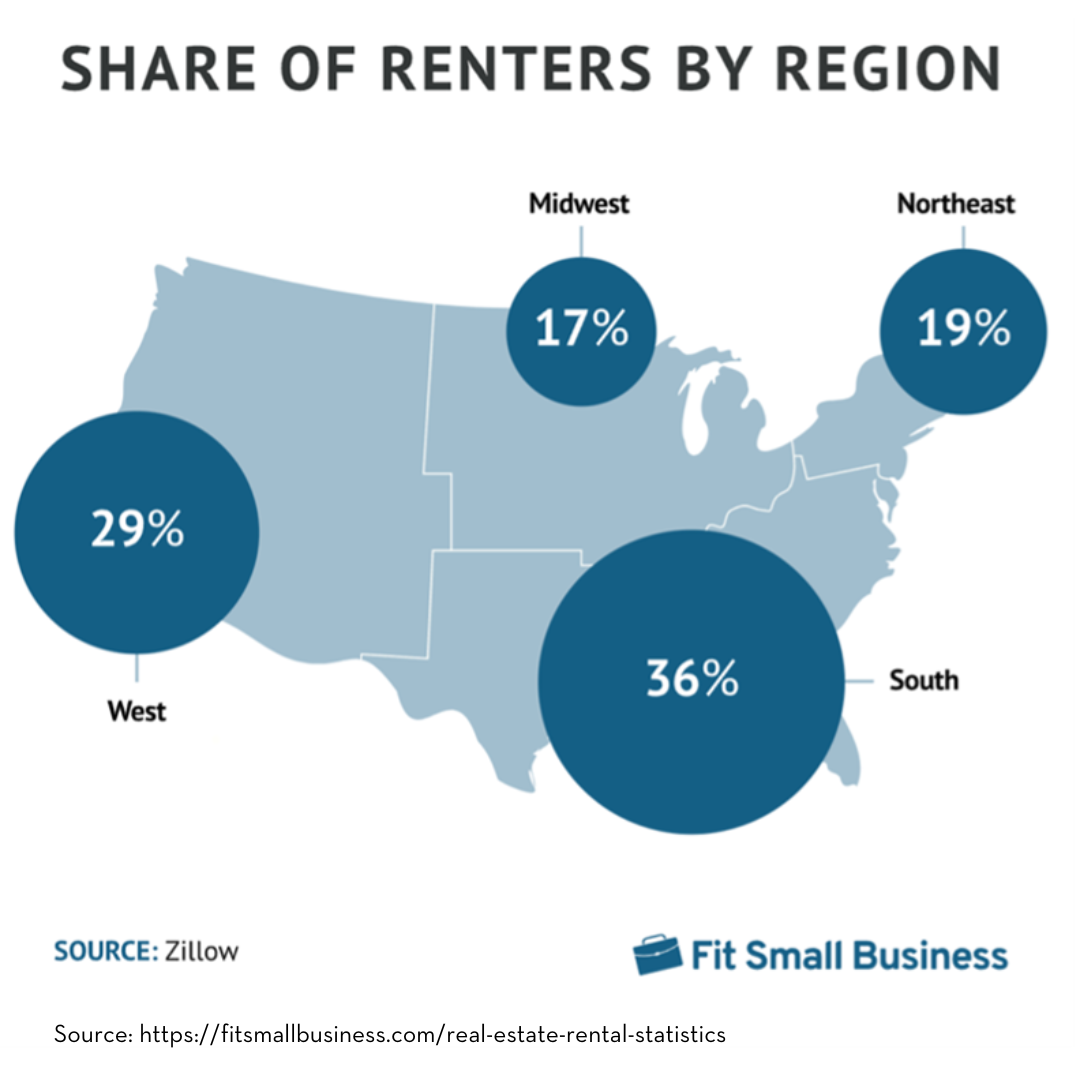
  • Demographics: Household formation remains strong, especially among Millennials and Gen Z renters. Did you know the United States now has over 100 million renters? (ApartmentList).

“The Fed’s cut didn’t just open a door – it nudged it wider. With demand resilience and construction retreating, the next few quarters may offer the best entry point in years.”

Looking Ahead to 2026

  • We expect supply pressure to gradually ease across major metros into 2026.
  • We expect more opportunities will emerge as over-leveraged and underperforming assets reset.
  • We continue to prioritize:
    • Strong submarkets with market tailwinds
    • Fixed-rate leverage
    • Discounted acquisition pricing
  • Disciplined, vertically integrated execution

Capital is coming off the sidelines—and it’s flowing back into multifamily. As the window of opportunity reopens, Ashcroft Capital is positioned to lead the next cycle of growth.

Sources & References:

Disclaimer:

Neither Ashcroft Capital LLC, nor any of its affiliated companies (collectively,” Ashcroft”), is an investment adviser or a broker-dealer nor are any of them registered with the U.S.

Securities and Exchange Commission. The information in this presentation should not be used as the sole basis of any investment decisions, nor is it intended to be used as advice with respect to the advisability of investing in, purchasing or selling securities, nor should it be construed as advice designed to meet the investment needs of any particular person or entity or any specific investment situation. Nothing in this presentation constitutes legal, accounting or tax advice or individually tailored investment advice.  This presentation is not an offer to buy or sell securities nor a solicitation of such offers.

The content in this presentation contains general information and may not reflect current developments or information. The information is not guaranteed to be correct, complete or current. The reader assumes responsibility for conducting its own due diligence and assumes full responsibility for any investment decisions.

Examples are provided for illustrative purposes only and are not necessarily indicative of potential investment results, nor does this material constitute an exhaustive explanation of the investment process, investment strategies or risk management.

This presentation contains forward-looking statements within the meaning of the federal securities laws. Forward-looking statements express Ashcroft’s expectations or predictions of future events or results. They are not guarantees and are subject to many risks and uncertainties. There are a number of factors beyond Ashcroft’s control that can cause actual events or results to be significantly different from those described in the forward-looking statements.  Any or all of the forward-looking statements in this document or in any other statements Ashcroft makes can turn out to be wrong. Except as required by applicable law, Ashcroft does not intend to publicly update or revise any forward-looking statements, whether as a result of new information, future developments or otherwise.  In light of the significant uncertainties inherent in the forward-looking statements made in this document, the inclusion of this information cannot be considered a representation by Ashcroft or any other person that its objectives, future results, levels of activity, performance or plans will be achieved.

Ashcroft Capital’s offerings are made pursuant to Regulation D, Rule 506(c) and are available only to verified accredited investors. Past performance is not indicative of future results. All investments carry risk, including the potential loss of principal. This presentation is for informational purposes only and should not be construed as an offer to sell or a solicitation of an offer to buy any securities.

Back to News Page

What the Fed’s Latest Rate Cut Means for Multifamily Real Estate Investors

September 24, 2025

Why Lower Rates Could Signal a Strategic Window for Long-Term Growth 

By: Travis Watts, Director of Investor Development

The Federal Reserve’s recent decision to cut interest rates on September 17th, 2025, was the first cut in over a year, and has reignited conversations across the investment world. While Wall Street recalibrates and headlines speculate on what’s next, seasoned investors understand one thing clearly: shifts in monetary policy often create opportunity. 

At Ashcroft Capital, we see this rate cut not just as a monetary adjustment—but as a potential catalyst for the multifamily sector. 

The Case for Optimism in Multifamily 

Lower interest rates reduce the cost of capital, which is particularly significant for real estate investors. In the multifamily space, this creates a more favorable environment for acquisitions, refinancing, and long-term value creation. For sponsors like Ashcroft, who maintain a vertically integrated operating model, this shift enhances our ability to act decisively in a changing landscape. 

We’ve seen this before: when rates decline, strong operators gain ground. Lower debt service requirements can widen cash flow margins, making well-located, value-add assets even more attractive. For investors, that can translate into more efficient capital deployment and the potential for stronger risk-adjusted returns. 

Strategic Implications for 2025 and Beyond 

While many groups remain cautious, Ashcroft continues to lean into its proactive strategy. Our recent acquisitions, including Halston Waterleigh, have been guided by deep market diligence, and an eye toward recovery in the commercial real estate market. The Fed’s move aligns with our broader thesis: that multifamily remains one of the most resilient and adaptable asset classes. 

Importantly, a single rate cut does not signal a return to the “easy money” era, but it does suggest that the Fed is attuned to broader economic pressures, including housing supply-demand imbalances. For multifamily investors, that’s a welcome signal. 

What This Means for Our Investors 

Ashcroft Capital’s investment approach is grounded in risk mitigation, operational excellence, and investor-first alignment. In a lower rate environment, our focus sharpens: 

  • We can pursue more accretive acquisitions, where stabilized cap rates are still elevated, but the cost of capital is easing. 
  • We enhance operational flexibility, from interest expense, potential refinances, and restructuring existing loans to help free up additional cash flow.  
  • We deepen our investor partnerships, with high-yield cash flow offerings such as the Ashcroft Income Note, to help investors generate cash flow even in a declining rate environment.  

In short, we view this as a window to double down on fundamentals. 

Final Thoughts 

The multifamily sector doesn’t move on headlines alone. It moves on demographics, demand, and discipline. With the Fed resuming rate cuts in 2025, the next chapter in multifamily investing is already underway. 

At Ashcroft Capital, we’re not waiting on the sidelines. We’re moving with intention—guided by experience, powered by strategy, and committed to helping our investors navigate whatever comes next. 

Interested in how today’s market could impact your portfolio? 

Connect with our team to explore current opportunities or learn more about our investment thesis for 2025 and beyond. 

——-

Explore our Current Offerings


Disclaimer: 

This material is for informational purposes only and is not intended as an offer to buy or sell securities or a solicitation of such offers. Any such offer will be made only through official offering documents and only to verified accredited investors as defined by Regulation D, Rule 506(c) of the Securities Act of 1933. 

This content may contain forward-looking statements, including references to potential regulatory developments and future access to private real estate investments through retirement accounts. These statements are subject to risks and uncertainties, and actual outcomes may differ materially. 

Past performance is not indicative of future results. All investments carry risk, including the potential loss of principal. Investors should consult their financial and legal advisors before making any investment decision. Ashcroft Capital does not provide tax, legal, or investment advice. Any discussion of potential tax-advantaged strategies is for illustrative purposes only and may not be available to all investors. This material does not constitute an offer to buy or sell securities or a solicitation of such offers. 

Back to News Page

Potential 401(k) Policy Shift Could Expand Access to Private Real Estate

September 3, 2025

By: Travis Watts, Director of Investor Development

401(k) Policy Private Real Estate

A new executive order signed by President Donald Trump directs the Department of Labor to explore expanded access to alternative assets in 401(k) retirement plans. While most public commentary has centered on private equity and hedge funds, the potential implications for private real estate investment are also worth examining. 

Key Considerations 

Traditionally, 401(k) plans have been limited to publicly traded securities like mutual funds and ETFs. The executive order encourages the Department of Labor to review existing guidance, potentially enabling plan sponsors to consider a broader range of professionally managed private market investments. 

If implemented, such changes could create opportunities for certain qualified investors to access real estate syndications and other private offerings within their 401(k) retirement account. However, regulatory, fiduciary, and administrative hurdles remain significant, and any policy shifts would take time to formalize and adopt. 

While the inclusion of private assets in retirement plans isn’t entirely new—the Department of Labor issued limited guidance in 2020—this executive order represents a far more expansive policy shift, with potential long-term implications for both investors and plan sponsors. 

Implications for Investors 

  1. Potential Retirement Account Access to Private Real Estate: While not yet actionable, this policy direction could pave the way for retirement custodians to explore private real estate options, including multifamily syndications, under appropriate structures.
  2. Growing Interest in Passive Income Strategies: Investors focused on income generation in retirement may benefit from access to offerings designed to deliver scheduled distributions and capital preservation, if allowed within 401(k) frameworks.
  3. Need for Institutional-Grade Sponsors: Any future access to private real estate within retirement plans will likely require sponsors to meet high standards for transparency, operational integrity, and track record—favoring firms with institutional readiness.  

Ashcroft Capital: Positioned for the Future 

Ashcroft Capital focuses exclusively on multifamily real estate investments, offering vertically integrated operations, and a retirement-aligned investment philosophy. If retirement plan access to private alternatives becomes available, Ashcroft is well-positioned to navigate the operational, regulatory, and custodial complexities. 

We continue to monitor developments closely and are committed to keeping investors informed as the regulatory landscape evolves. 

(Explore Our Current Offerings) 

(Connect With Our Team And Learn More) 


Disclaimer: 

This material is for informational purposes only and is not intended as an offer to sell or a solicitation to purchase securities. Any such offer will be made only through official offering documents and only to verified accredited investors as defined by Regulation D, Rule 506(c) of the Securities Act of 1933. 

This content may contain forward-looking statements, including references to potential regulatory developments and future access to private real estate investments through retirement accounts. These statements are subject to risks and uncertainties and actual outcomes may differ materially. 

Past performance is not indicative of future results. All investments carry risk, including the potential loss of principal. Investors should consult their financial and legal advisors before making any investment decision. 

Ashcroft Capital does not provide tax, legal, or investment advice. Any discussion of potential tax-advantaged strategies is for illustrative purposes only and may not be available to all investors. This material does not constitute an offer to buy or sell securities or a solicitation of such offers. 

Back to News Page

New Tax Law, New Opportunity: What the Big Beautiful Bill Means for Real Estate Investors

July 23, 2025

By: Travis Watts, Director of Investor Development

A Subtle but Significant Shift 

Every so often, a change in tax policy comes along that doesn’t just move the needle — it reinforces why many of us invest in real estate in the first place. That’s what we’re seeing now with the mid-2025 passage of what’s been informally dubbed the “Big Beautiful Bill.” 

While much of the media attention has focused on corporate rates or political talking points, the bill quietly delivers substantial advantages for real estate investors — particularly qualifying Limited Partners (LPs) in syndications like those we manage at Ashcroft. 

At its core, this legislation restores key provisions that enhance the long-term tax efficiency of real estate income and improve the cash flow profile of well-managed deals. 


The Three Tax Changes LPs Should Pay Attention To 

 1. 100% Bonus Depreciation Restored Through 2029

This is one of the most impactful changes for qualifying LPs. For qualifying properties placed in service after January 19, 2025, investors may now benefit from full bonus depreciation in the first year. 

This allows us to accelerate the depreciation schedule — creating sizable paper losses that offset passive income. In the right circumstances, that may result in significantly reduced tax liability in year one. 

Why it matters: For many investors, especially in high-income years or following a liquidity event, this can be a meaningful planning tool to retain more capital while maintaining real estate’s income potential. 

Ashcroft’s Halston Northlake offering is timed well for this provision and is positioned to take full advantage. 

 2. Section 199A – 20% Pass-Through Deduction Made Permanent

Qualifying investors in real estate partnerships will continue to benefit from the ability to deduct up to 20% of qualified business income (QBI). This isn’t a flashy headline, but it’s a foundational component of real estate’s long-term tax efficiency. 

Why it matters: With the deduction now permanent, it provides greater predictability when planning future distributions and after-tax returns — particularly important for LPs evaluating multi-year hold strategies. 

 3. Interest Deduction Enhancement Under Section 163(j)

This technical fix allows sponsors to add back depreciation when calculating how much interest expense can be deducted. 

Why it matters: It allows us, as operators, to deduct more interest, which ultimately strengthens deal-level cash flow. When our assets operate more efficiently, investors benefit — whether through distributions, reinvestment, or stronger performance over time. 


What Didn’t Change — And Why That Matters 

Just as important as the updates are the aspects that remained unchanged. The 1031 Exchange remains fully intact, preserving one of the most powerful tools available for deferring taxes and compounding wealth over time.  

Additionally, the regulations around carried interest and SALT cap limits were left untouched, meaning that common investor strategies remain viable and unaffected. For limited partners pursuing long-term strategies and reinvestment plans, these elements continue to serve as foundational pillars—and their stability should not be overlooked. 


Why This Is Timely: The Northlake Opportunity 

Halston Northlake is aligned with this new tax landscape. It qualifies for 100% bonus depreciation, benefits from enhanced interest deductibility, and allows qualifying LPs to take full advantage of the QBI deduction. 

Timing matters in real estate. And the timing here is working in your favor. 

In a market where many are still sitting on the sidelines, this legislation reinforces the long-standing benefits of owning real assets — and Northlake is positioned to take advantage immediately. 

Key Takeaways for Investors 

  • These aren’t theoretical updates — they’re live. 
  • Ashcroft deals like Halston Northlake are positioned to fully leverage the new provisions. 
  • If you’re an LP with high passive income or planning near-term investments, this tax law could directly benefit your bottom line. 

Let’s Talk 

If you’d like to understand how your current or future investments could benefit under the new law, we’d be happy to walk through the specifics. 

Schedule a Call with Investor Relations Today 

Disclaimer: The offering referenced herein is available only to verified Accredited Investors under The Securities Act of 1933, Regulation D, Rule 506(c). This material is provided for informational purposes only and does not constitute legal, tax, or investment advice. Investors should consult their personal legal and tax advisers to understand how recent legislation may apply to their specific financial situation. Any references to projected performance or tax benefits are illustrative only and not guaranteed. There is no assurance any investment will achieve its objectives or that investors will receive a return of capital. Past performance is not indicative of future results. This information was derived from sources Ashcroft deems reliable, but Ashcroft does not guarantee its accuracy or completeness. 

Back to News Page

Q3 2025 Ashcroft Insights Market Report

July 1, 2025

Q3 2025 Market Report

As we enter the third quarter of 2025, the U.S. multifamily real estate sector stands at a critical inflection point. Following years of historic rent volatility, record supply pipelines, and macroeconomic headwinds, the market is now showing clear signs of stabilization and renewed momentum. Key performance indicators across occupancy, absorption, and transaction activity reveal a sector in the early stages of recovery — one that is increasingly supported by strong demand fundamentals, constrained new construction, and an anticipated shift in monetary policy. 

Key areas of focus include: 

  • Rent Recovery in Motion: Tracking the Rebound in Multifamily Demand 
  • Holding Pattern or Pivot Point? Inside the Fed’s 2025 Rate Trajectory 
  • From Boom to Balance: Navigating the New Construction Landscape 
  • Tightening the Gap: Occupancy and Vacancy as Renters Return  
  • Deals, Debt & Discipline: How Investors Are Moving in Q3 

Rent Recovery in Motion: Tracking the Rebound in Multifamily Demand

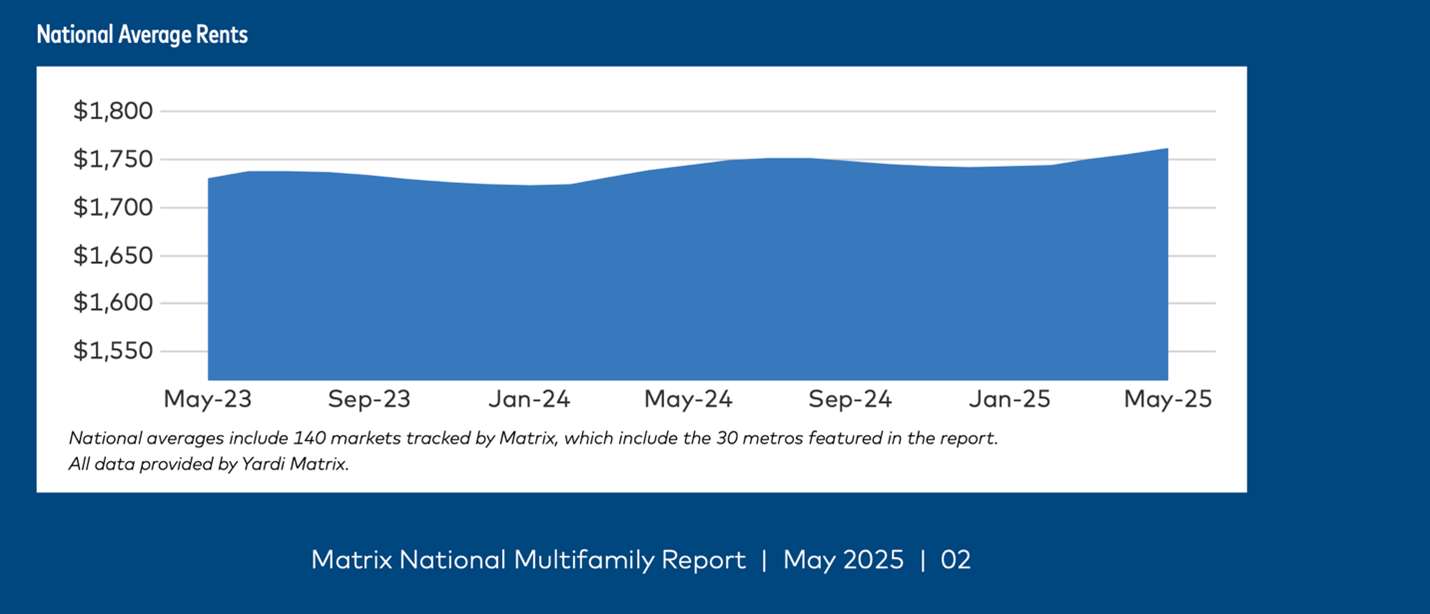
May 2025 Rent RecoverySource: https://www.yardimatrix.com/publications/download/file/7359-MatrixMultifamilyNationalReport-May2025?signup=false


Multifamily rent growth continues to modestly rebound after a period of supply-driven softness. Outlooks for 2025 remain cautiously positive: Zillow anticipates
+1.6% annual rent growth, while Yardi Matrix forecasts approximately +1.5% nationally. These projections reflect expanding demand aligned with robust Q2 leasing. 

By May, Yardi reported the average U.S. advertised asking rent increased to $1,761, marking a $6 month-over-month increase and maintaining a +1.0% YoY rate. Although growth remains tame compared to historic norms, it indicates stabilization following the volatility of 2023–24. 

Demand for apartments also remains strong. RealPage recorded 138,300 market-rate units absorbed in Q1 2025, the most active start to a year in over three decades. But Q2 surpassed that milestone—RealPage forecasts indicate an additional 156,000 units absorbed in Q2, maintaining the elevated demand momentum. Combined, approximately 294,000 units were absorbed through the first half of the year—a pace comparable to the early peak of 2021. 

This demand surge reflects multiple underlying factors: 

  • Strong job and wage growth continue to support housing needs. 
  • Improving affordability increases renter retention and household formation. 
  • Single-family market strain from high home prices reinforces multifamily viability. 

Looking ahead, the strong first half of 2025 positions the multifamily sector for continued strength into Q3 and Q4. While supply remains near historic highs, demand is clearly matching the pace, stabilizing occupancy and supporting modest rent growth. Given the anticipated tapering of new deliveries in late 2025, conditions are primed for rent growth to trend upward into 2026, especially in markets with limited new supply. 

Sources:
BARRONS
YARDIMATRIX
REALPAGE

Holding Pattern or Pivot Point? Inside the Fed’s 2025 Rate Trajectory

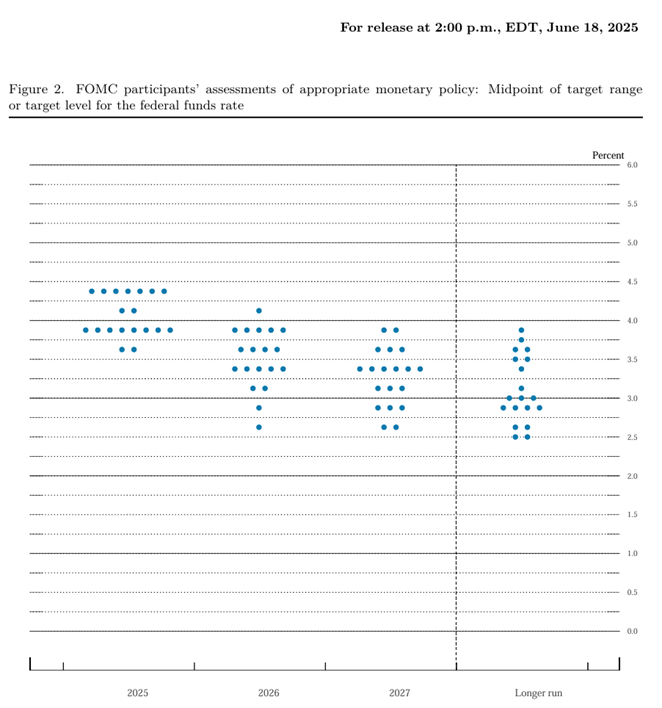
Fed Release June 25Source: www.federalreserve.gov/monetarypolicy/files/fomcprojtabl20250618.pdf


At the
June 18th, 2025 FOMC meeting, the Federal Reserve maintained its benchmark federal funds rate at 4.25%–4.50%, holding steady for the seventh consecutive month. While inflation has cooled from its 2022–2023 highs, the Fed continues to emphasize its “data-dependent” approach, citing a need for more sustained progress toward its 2% inflation target before considering cuts. 

Recent commentary from Fed Chair Jerome Powell reflects a cautious tone, noting: 

“We’ve seen encouraging signs on inflation, but we are not yet confident enough to begin easing policy. Labor markets remain tight, and services inflation is still sticky.” 

The futures market continues to price in a potential rate cut in Q4 2025, although that outlook remains fluid. For the multifamily sector, sustained elevated rates have translated into: 

  • Loan pricing that is typically in the 6.0%–6.5% range, with lenders tightening terms. 
  • Increased investor appetite for fixed-income alternatives, like structured note offerings. 
  • A flight to quality, favoring Class A and stabilized assets with strong cash flow. 

The current rate environment reinforces the importance of disciplined underwriting, proactive debt management, and active asset management to navigate ongoing macroeconomic volatility.  

Sources:
REUTERS
FEDERALRESERVE.GOV
FEDERALRESERVE.GOV(2)

From Boom to Balance: Navigating the New Construction Landscape

2025 Construction

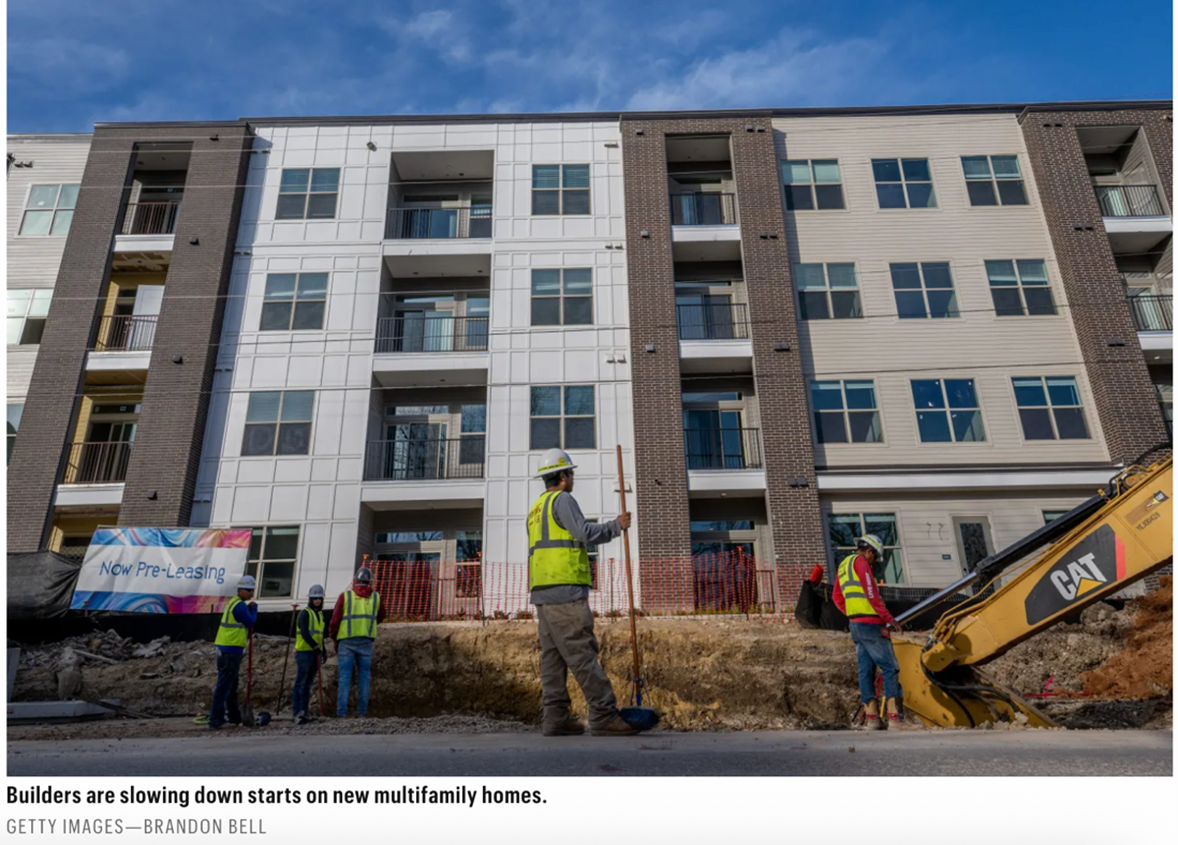
Multifamily construction activity continues to moderate as we enter the second half of 2025 across the U.S. as developers respond to a challenging mix of elevated borrowing costs, slowing rent growth, and heightened operational expenses. Builders are pulling back, and the effects are beginning to show in both permit activity and project starts. 

  • Completions are down ~28% since last summer’s peak, according to U.S. Census Bureau data, as cited by Freddie Mac, marking a significant cooldown in pipeline deliveries. Industry analysts anticipate further declines throughout 2025, which may offer relief to oversupplied markets and help stabilize rent growth. 
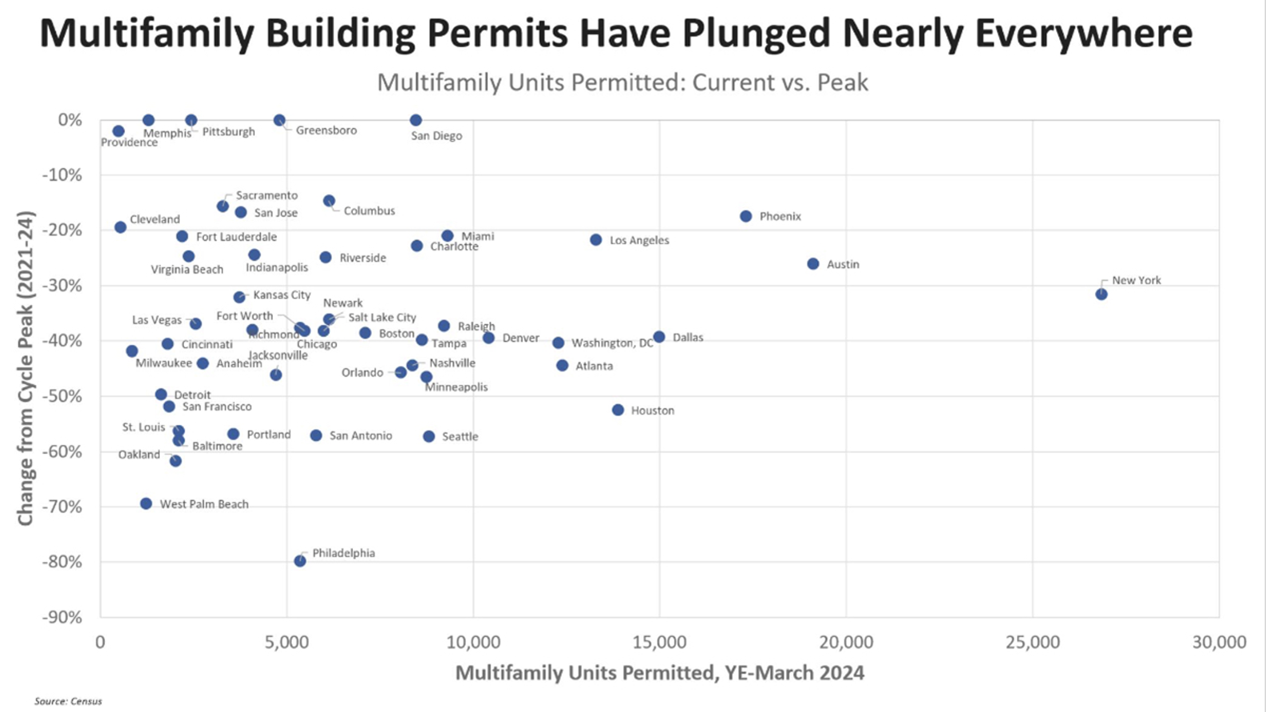
  • Permit activity has dropped sharply across many U.S. metros. Developers cite underwriting challenges and higher construction costs as deterrents to new project launches. 
  • Orlando, one of the most active multifamily markets in the last cycle, is now experiencing a pronounced pullback.
    • Starts fell by ~60% in 2024. 
    • Completions are slowing into 2025. 
    • Rent growth is forecasted to reach a modest +2.4% by year-end 2025, indicating a more balanced market ahead. 

This construction slowdown, while painful for some developers, is a necessary reset after years of record-breaking deliveries. As new supply levels off and demand remains steady, the market is poised to enter a healthier equilibrium. For investors, this means improved pricing power, more stable occupancy, and potentially stronger cash flow margins in 2026 and beyond — particularly in supply-constrained submarkets. 

Sources:
BARRONS
AXIOS
MARKETWATCH
FREDDIEMAC

Tightening the Gap: Occupancy and Vacancy as Renters Return

Waterleigh 2025


National multifamily fundamentals remain resilient, with leasing activity continuing to absorb new supply and demand holding firm despite a high volume of completions.
 

Absorption Trends 

As mentioned previously, approximately 294,000 units were absorbed in the first half of the year — putting the market on pace with 2021’s strong post-pandemic recovery. RealPage further indicates that annual demand has exceeded supply for two consecutive quarters — a trend historically lasting seven quarters — reinforcing this positive cycle. 

  • RealPage reported occupancy in the 94.2%–95.7% range through Q2, with recent data from Yardi Matrix reporting 94.4%. 

Vacancy Rates

With this level of occupancy and continued deliveries, the national vacancy rate floats in the mid 5% range (~5.8%), closely mirroring expectations after Q2 stabilization. 

Outlook 

  • Occupancy is poised to stabilize: With rent growth settling at ~1%, occupancies in the mid 94% range represent a balanced equilibrium under current supply dynamics. 
  • Strengthening demand rebound: Continued strong absorption suggests demand remains robust even as the pipeline delivers. 

Sources:
CREDAILY
YARDIMATRIX
CARBON RE INVESTMENTS

Deals, Debt & Discipline: How Investors Are Moving in Q3

2025 Deals


The multifamily investment landscape continues to strengthen as we enter Q3. Despite an elevated rate environment, transactional momentum has not only returned — it’s accelerating.
 

Transaction activity remains robust. As a reminder, first-quarter investment sales reached approximately $30 billion, up 35.5% year-over-year, and prompted a strong Q2 as well.  

Strength across regions: 

  • The Southeast is seeing record demand: Q1 absorption in markets such as Atlanta has surpassed 56,000 units, matching the sum of 2021–2023 combined totals. 
  • Dallas–Fort Worth, a key growth market in 2025, posted a 23% year-over-year increase in transaction volume, with Q1 sales reaching $1.42 billion, nearly double the $637 million recorded in Q1 2024.  

Lending remains selective yet active. 

In Q2, the rebound persisted, with debt issuance remaining solid. While Q2 numbers are still being finalized, early Trepp data shows that bank-originated multifamily loans experienced a 67% YoY jump in Q1, suggesting Q2 maintained similar momentum.  

  • Early CBRE data also highlights a 13% QoQ rise in its Lending Momentum Index for commercial lending in Q1—suggesting a strong pipeline heading into Q2.
  • Loan rates average ~6.2%, reflecting the sustained impact of elevated Treasury yields.
  • Lender caution is evident, with underwriting focused on stabilized assets, moderate leverage (55–65% LTV), and borrower track records — particularly in bridge-to-perm and refinance solutions amid 2026 maturities. 

Looking ahead, the expectation of Fed rate reductions later this year—part of a wider “Fed pivot” toward mid-3 percent policy rates—could usher in enhanced debt affordability and increased deal flow. Strong absorption and weakening new deliveries reinforce a favorable environment for operators and investors in the back half of 2025. 

Sources
NEWMARK
REALPAGE
CBRE
TREPP
MMG


Conclusion 

The first half of 2025 has been marked by rising demand, moderating supply, and a subtle but growing shift in investor sentiment. Multifamily housing continues to outperform expectations, particularly in supply-constrained and high-growth submarkets. National absorption through Q2 has reached nearly 300,000 units — one of the strongest year-to-date performances on record — while new project starts and permits decline sharply. This recalibration between demand and supply is setting the stage for improved pricing power, tighter vacancy rates, and stabilized rent growth as we look ahead. 

While interest rates remain elevated, the forward-looking narrative from the Fed suggests that relief could arrive in late 2025 or early 2026. In the meantime, investors are increasingly shifting capital into cash-flowing real assets that can offer insulation against inflation and economic uncertainty. This is particularly true for multifamily, where fundamentals remain intact, and the structural demand for rental housing continues to outpace delivery schedules. 

Ashcroft Capital remains committed to delivering institutional-quality investments through a proven platform and experienced leadership team. Whether through our equity syndications or note offerings, our mission is to offer investors access to resilient, risk-adjusted opportunities in one of the most enduring real estate sectors in the U.S. economy. 

We appreciate your continued trust and look forward to navigating the remainder of 2025 with clarity, focus, and disciplined execution. 

Disclaimer: The offering discussed herein is available only to verified Accredited Investors under The Securities Act 1933, Regulation D, Rule 506(c). 

Neither Ashcroft Capital LLC, nor any of its affiliated companies (collectively,” Ashcroft”), is an investment adviser or a broker-dealer nor are any of them registered with the U.S.

Securities and Exchange Commission. The information in this presentation should not be used as the sole basis of any investment decisions, nor is it intended to be used as advice with respect to the advisability of investing in, purchasing or selling securities, nor should it be construed as advice designed to meet the investment needs of any particular person or entity or any specific investment situation. Nothing in this presentation constitutes legal, accounting or tax advice or individually tailored investment advice. This presentation is not an offer to buy or sell securities nor a solicitation of such offers, 

The content in this presentation contains general information and may not reflect current developments or information. The information is not guaranteed to be correct, complete or current. The reader assumes responsibility for conducting its own due diligence and assumes full responsibility for any investment decisions.  

Examples are provided for illustrative purposes only and are not necessarily indicative of potential investment results, nor does this material constitute an exhaustive explanation of the investment process, investment strategies or risk management.  

This presentation contains forward-looking statements within the meaning of the federal securities laws. Forward-looking statements express Ashcroft’s expectations or predictions of future events or results. They are not guarantees and are subject to many risks and uncertainties. There are a number of factors beyond Ashcroft’s control that can cause actual events or results to be significantly different from those described in the forward-looking statements.  Any or all of the forward-looking statements in this document or in any other statements Ashcroft makes can turn out to be wrong. Except as required by applicable law, Ashcroft does not intend to publicly update or revise any forward-looking statements, whether as a result of new information, future developments or otherwise.  In light of the significant uncertainties inherent in the forward-looking statements made in this document, the inclusion of this information cannot be considered a representation by Ashcroft or any other person that its objectives, future results, levels of activity, performance or plans will be achieved.  

Back to News Page

Resident Retention as a Growth Strategy: How Halston Waterleigh Is Setting the Standard

May 28, 2025

By: Travis Watts, Director of Investor Development

Momentum You Can Measure 

In today’s multifamily landscape, retention isn’t just a metric—it’s about returns. At Ashcroft Capital, we view resident satisfaction as a powerful lever for operational stability and long-term asset value. Halston Waterleigh offers a clear example of how strategic retention initiatives can drive performance on multiple levels—from leasing velocity to net-operating-income growth. 

Over the past 30 days alone, 31 new residents have moved into Halston Waterleigh—at rents $50 above the existing rent roll. Simultaneously, we implemented a $25–$100 rent increase property-wide. The result? Accelerated leasing activity and stronger pricing power, underscoring both resident demand and our team’s execution strength. [Data as of May 19, 2025.] 

Retention as Revenue Strategy 

Since acquiring the asset, lease renewal rates have climbed from ~45% to nearly 60%. Every retained resident represents reduced turnover cost, steadier cash flow, and higher overall occupancy—key drivers of durable asset performance. *Data as of May 19, 2025.


Bilingual Teams, Local Engagement 

A core reason for Waterleigh’s strong retention trajectory is our local team. Our bilingual (Portuguese-speaking) staff has forged strong ties with the Brazilian-American population in the submarket. That cultural alignment has translated into improved engagement, higher satisfaction, and “stickier” leases.


Resident Experience, Elevated 

At Halston Waterleigh, we view hospitality as infrastructure. Our team curates at least two resident events per month, supported by weekly food trucks and lifestyle-driven programming.  

Popular recent events include: 

  • Painting with a Twist – a wine and art social 
  • Mixology Nights 
  • Monthly Yoga Sessions – co-hosted with our adjacent Birchstone property 

Events aren’t just amenities—they’re strategic tools that turn units into homes and neighbors into community. 

Efficiency at Scale: Strategic Expansion 

Ashcroft recently acquired the neighboring asset—formerly Ascend Waterleigh Club—in an institutional joint venture. This expansion unlocks meaningful operational synergies, including shared staffing, vendors, and resident amenity access. These efficiencies translate into enhanced margins and greater net-operating-income potential across both properties. 

Security & Confidence Through Presence 

Our Courtesy Officer Program, featuring an on-site sheriff, adds another layer of value. In exchange for a housing discount, the officer assists with: 

  • On-call security checks 
  • Pool lock-up and common area monitoring 
  • Attendance at resident events 

It’s a low-cost, high-impact program that improves safety perceptions and strengthens community trust.


Innovative Leasing & Communication 

Birchstone’s high-touch management model supports our communities with: 

  • Automated renewal nudges and resident surveys 
  • Price-drop alerts and availability campaigns 
  • Onsite check-ins and retention-focused communication 

By streamlining the resident lifecycle, we not only enhance satisfaction—we preempt turnover. 

Value Creation by the Numbers 

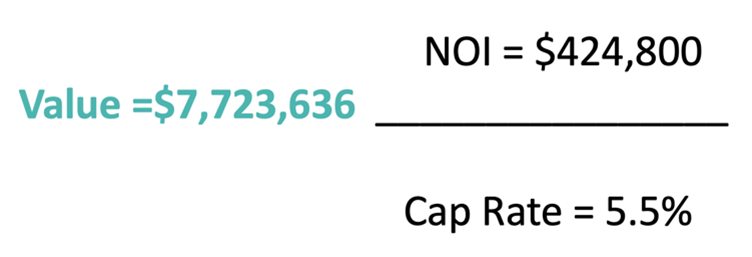
Halston Waterleigh was acquired at a 5.5% cap rate, while the surrounding submarket now trades at ~4.8%. This spread creates a clear valuation lift for our investors—made more durable by rising retention and organic income growth. 

And the upside potential doesn’t stop there. We estimate $75–$100 in additional rent lifts are still in play across the portfolio. That equates to approximately $30,000 in monthly incremental income—a pipeline of growth already in motion. 

The Takeaway for Investors 

Resident retention is more than an operational metric. At Ashcroft, we invest in teams, technology, and strategies that increase the lifetime value of each lease. Halston Waterleigh is proof that a thoughtful, localized retention strategy can generate both community loyalty and measurable investor upside. 

Want the visual story? [Watch the Property Video] 

This offering is currently open to accredited investors [Learn More]  


Disclaimer: The offering referenced herein is available only to verified Accredited Investors under The Securities Act of 1933, Regulation D, Rule 506(c). 

There is no assurance an investment will achieve the projected returns or that investors will receive a return of capital or a return on investment in the projected timeframe or at all. Projections are based on assumptions Ashcroft believes reasonable based on its past experience with similar investments. Past performance is no guarantee of future results, which may vary widely due to circumstances beyond Ashcroft’s control. 

This information was derived from sources Ashcroft deems reliable. However, Ashcroft cannot provide assurances as to whether the information provided by these other sources is accurate, current or complete. 

Back to News Page

Q2 2025 Ashcroft Insights Market Report 

April 8, 2025

Ashcroft Insights Market Report Q2 2025

As we enter the second quarter of 2025, the U.S. multifamily real estate sector remains resilient despite a backdrop of economic uncertainty and shifting government policy. This report outlines the key trends, data points, and what we’re seeing in the market, so you can navigate this year with confidence.  

Key areas of focus include: 

  • Multifamily Market Stabilization and Rent Trends 
  • Interest Rate Outlook  
  • Construction Pipeline and Supply Trends  
  • Evolving Housing Preferences and the Case for Renting 
  • Investor Sentiment and Investment Volume 


Multifamily Market Stabilization 

Matrix March 2025

YardiMatrixMultifamily National Report 

U.S. multifamily asking rents hover around $1,755 according to Yardi Matrix. Effective rent growth is holding around 1% year-over-year, and the U.S. multifamily sector is showing encouraging signs of stabilization.  

National vacancy rates remain steady at approximately 5%, though muted compared to pandemic-era highs, this consistency signals solid demand fundamentals. Multifamily lending activity has increased 27% year-over-year from $246 billion to $312 billion, which represents the first calendar year of growth since 2021. 

Nationally, new deliveries continue to hit the market, but absorption remains robust. Strong demographic drivers, including delayed homeownership and in-migration to high-growth markets, are sustaining occupancy in many regions. Sun Belt metros such as Dallas-Fort Worth, Tampa, and Charlotte continue to outperform, buoyed by population gains and business expansion. 

These trends point to a resilient and stabilizing multifamily market. In our view, 2025 is a compelling environment to capitalize on cash flowing multifamily opportunities that have long-term upside appreciation—especially in high-growth markets where fundamentals remain strong. *See our offerings page for current opportunities.  

Sources: 

Lument: Multifamily Stable Amid Strengthening Demand 

Yardi Matrix – National Multifamily Market Report (Feb 2025) 

This information was derived from sources Ashcroft deems reliable. However, Ashcroft cannot provide assurances as to whether the information provided by these other sources is accurate, current or complete. 


Interest Rate OutlookFederal Reserve March 25

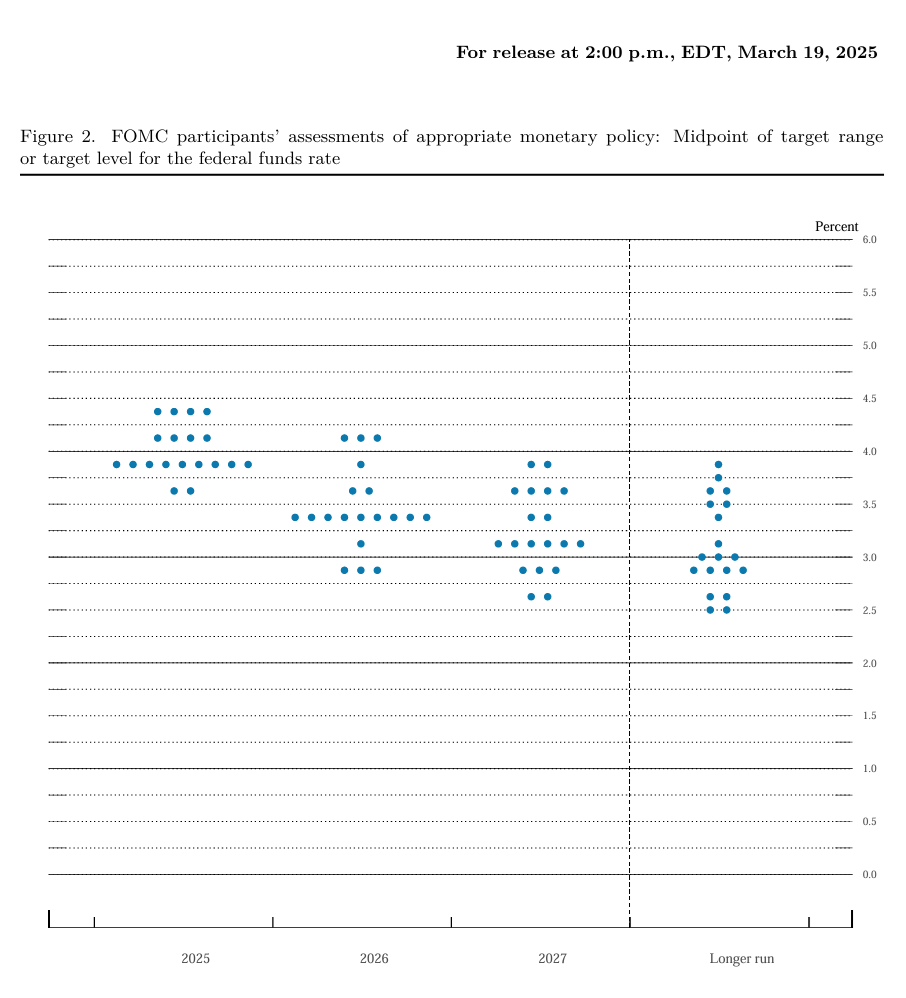
Federal Reserve March 2025 FOMC Projections 

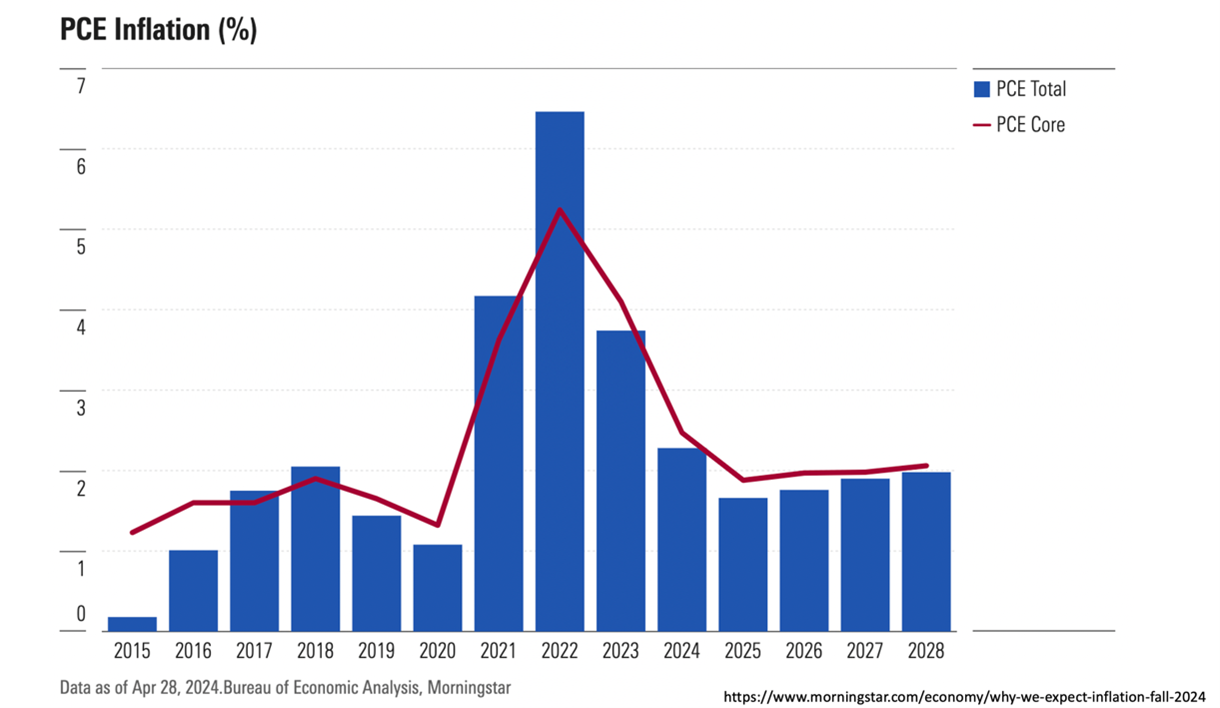
The Federal Reserve held its benchmark rate steady at 4.25%-4.50% in March 2025. This marks a cautious approach amid mixed economic indicators and inflation lingering near 2.7%, above the Fed’s 2% target. Despite market anticipation of multiple rate cuts this year, the Fed has signaled a wait-and-see stance, influenced by economic volatility and global trade policy.  

 This policy position presents both challenges and opportunities for multifamily stakeholders: 

  • Refinancing Constraints: Borrowers hoping to refinance at lower rates may need to wait longer as spreads remain elevated.
  • Asset Valuation Pressure: Cap rates have stabilized but are unlikely to compress significantly until rates decline further. 
  • Capital Market Reengagement: Clarity around rate direction could spur renewed lending and transaction activity, particularly for stabilized core assets. 

Nevertheless, investor expectations remain upbeat, however, with many analysts forecasting one or two cuts in the second half of 2025, we are cautiously optimistic that multifamily lending will see a lift in the back half of the year.  

Sources: 

Federal Reserve March 2025 FOMC Projections 

Reuters: Inflation and Fed Policy Outlook 

Axios: Fed Holds Steady Amid Market Uncertainty  

This information was derived from sources Ashcroft deems reliable. However, Ashcroft cannot provide assurances as to whether the information provided by these other sources is accurate, current or complete. 


Construction Pipeline and Supply Trends 

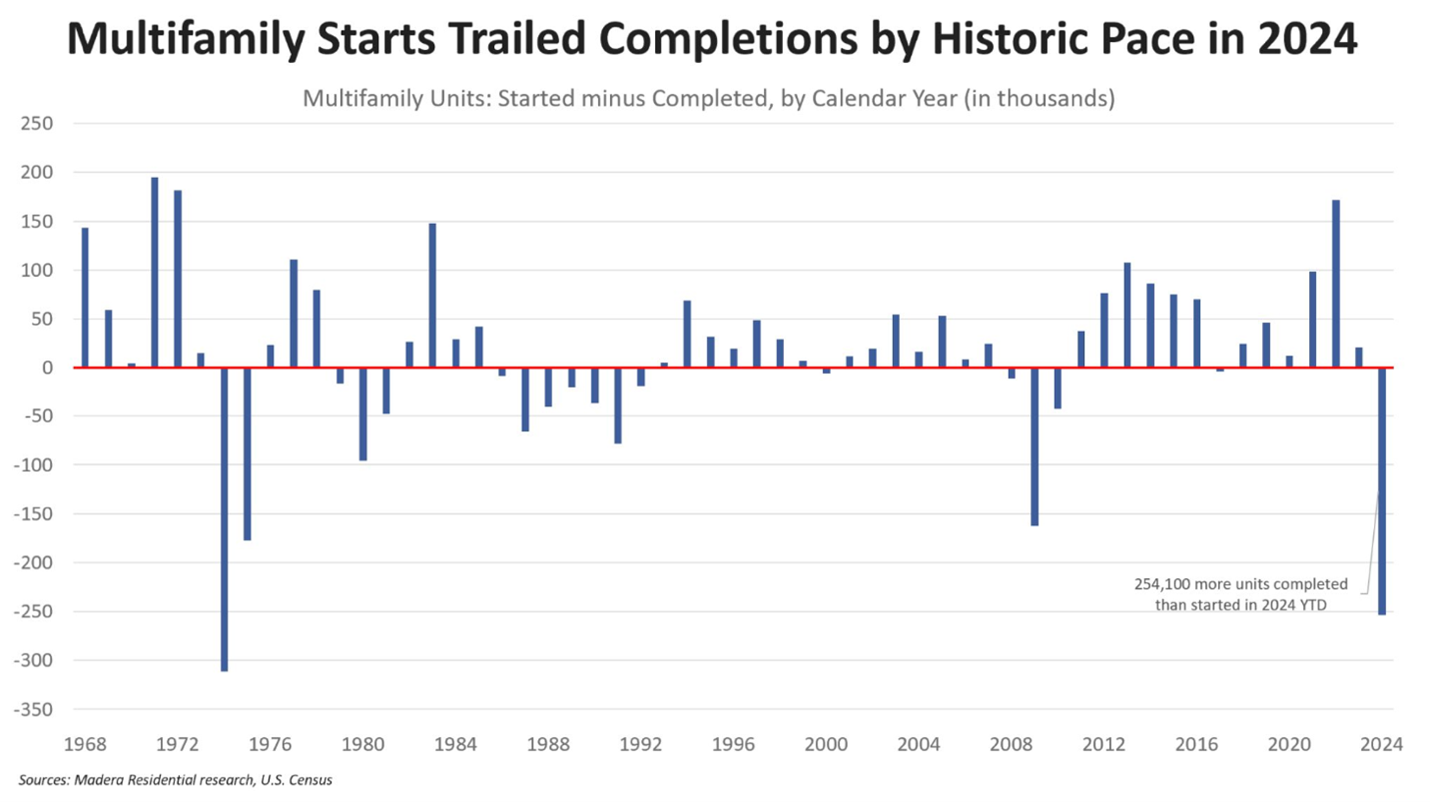
Multifamily Starts Multifamily construction starts have decelerated significantly due to elevated interest rates, wage inflation and commercial repricing since 2022. According to rental housing economist Jay Parsons, multifamily builders started 254,100 fewer units than they completed in 2024. That’s the second-biggest deficit on record (behind only 1974), and another indicator that new apartment supply is set to plunge by 2026. Additionally, total multifamily starts in 2024 came in lower than any year since 2013, when the country was still pulling out of the Great Financial Crisis. Labor constraints, elevated materials pricing, and financing difficulties continue to hinder new starts.  

In the Sun Belt, construction remains active but is increasingly concentrated in select suburban submarkets with strong absorption metrics and favorable zoning policies. Austin, Tampa, and Raleigh are examples of metros still seeing pipeline momentum, driven by job growth and in-migration. Conversely, coastal and high-barrier markets such as San Francisco, Los Angeles, and New York are experiencing greater slowdowns due to zoning challenges, softening rent growth, and longer lease-up timelines. 

Overall, this construction cooldown is helping rebalance supply and demand dynamics in markets that saw record deliveries from 2022 to 2024. Analysts expect this pause to support more sustainable rent growth in the coming 12–18 months, preserving pricing power for landlords and improving fundamentals for investors. 

Sources: 

NAHB Multifamily Starts Report Q1 2025 

Yardi Matrix U.S. Supply Trends Q1 2025 

RealPage Market Analytics  

Jay Parsons – Rental Housing Economist  

This information was derived from sources Ashcroft deems reliable. However, Ashcroft cannot provide assurances as to whether the information provided by these other sources is accurate, current or complete. 


Shifting Housing Preferences 

FannieMae Home Purchase SentimentFannieMae Home Purchase Sentiment Index

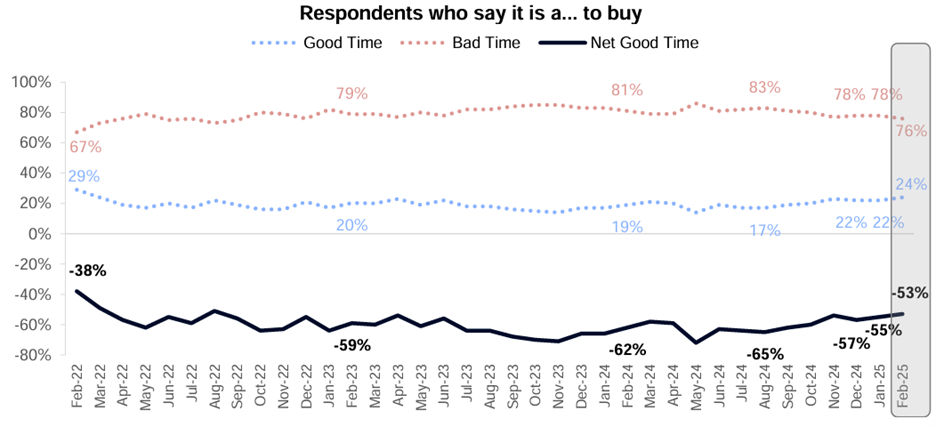
Recent surveys from Fannie Mae and Zillow confirm that the “rent vs. buy” decision continues to tilt in favor of renting. As of February 2025, 76% of surveyed consumers believe it is not a good time to buy a home, although this is down from 78% in January largely due to mortgage rates reducing slightly since the start of the year. Contributing factors for renting being more favorable include: 

  • Mortgage rates remaining “high” between 6.25% and 6.5% 
  • Near record-high home prices and constrained inventory 
  • Wages have not kept pace with housing costs 
  • Many younger buyers are burdened with student loan debt and rising living costs 
  • Ongoing uncertainty around job security and economic stability 

The median first-time homebuyer has reached an all-time high age of 38 years old. Renting remains a more flexible and accessible alternative for many households—especially Millennials and Gen Zers. Lifestyle amenities, lower maintenance burdens, and geographic mobility continue to be popular trends among renters in 2025.  

At Ashcroft Capital, we continue to cater to these preferences by offering co-working lounges, best-in-class fitness centers, package lockers, pet-friendly policies, and by hosting community events. These initiatives continue to reinforce demand for our Class A and Class B properties.  

Check out our Ashcroft Capital + Birchstone Residential spotlight video to learn more.  

Sources: 

Fannie Mae Home Purchase Sentiment Index 

National Association of Realtors – CNBC  

This information was derived from sources Ashcroft deems reliable. However, Ashcroft cannot provide assurances as to whether the information provided by these other sources is accurate, current or complete. 


Investor Sentiment & Investment Volume 

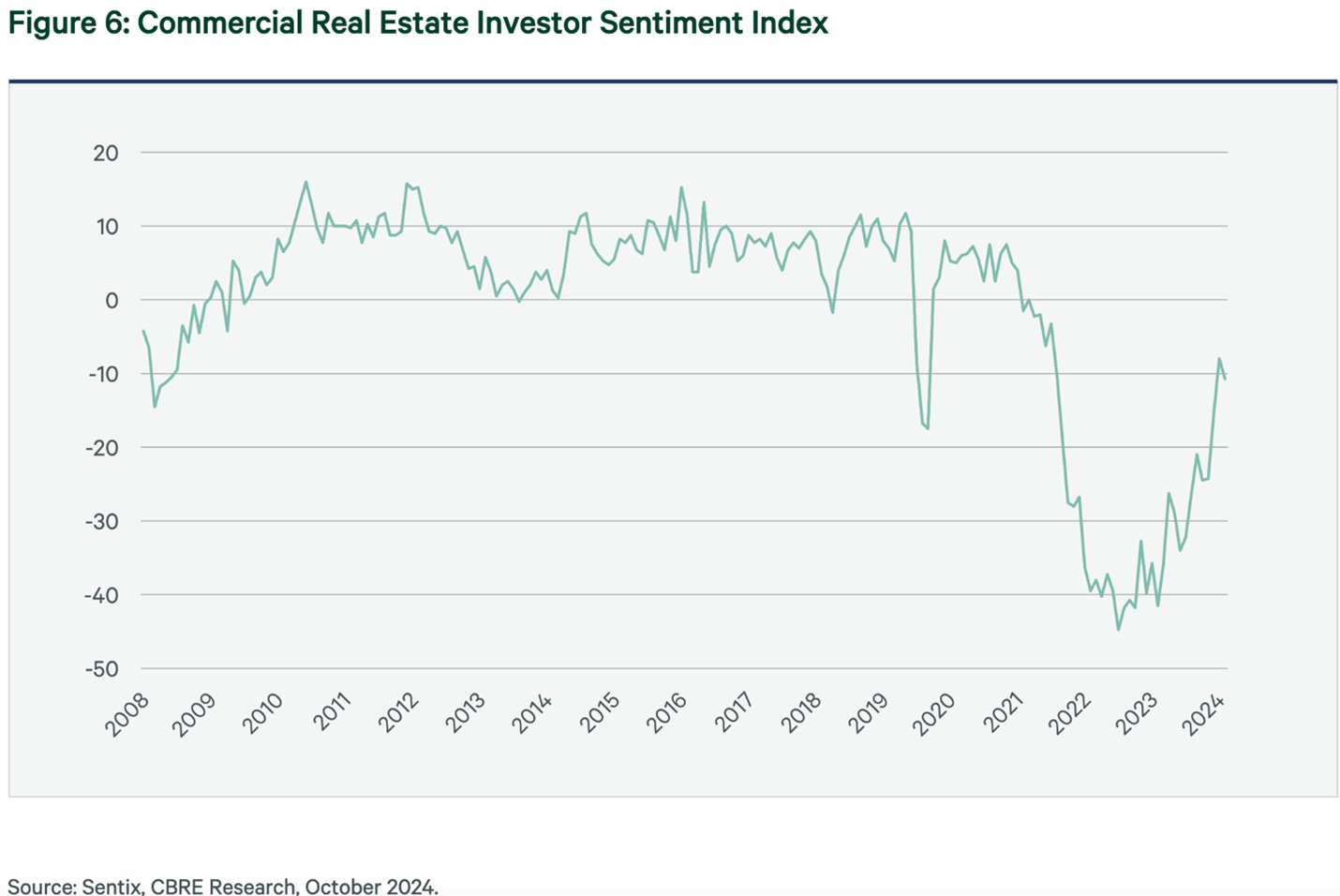
Commercial Real Estate Investor SentimentCBRE Market Outlook 2025

CBRE – U.S. Real Estate Market Outlook 2025 

CBRE expects a continued recovery for investment sales in 2025, with volume up by as much as 10% by the end of 2025. Despite recent macroeconomic and stock market volatility, investor sentiment for multifamily apartments continues to improve. CBRE’s latest capital markets survey indicates that investors are selectively re-entering the market, favoring: 

  • Value-Add Class B Workforce Housing (Strong demand + limited new supply) 
  • Core-Plus Class A and B in Suburban/Sub-Sunbelt Markets (High-growth metros like Orlando, Raleigh, Tampa, and Dallas-Fort Worth remain favored) 

Capital sources are increasingly favoring multifamily over office or retail, given multifamily’s relative performance, demographic tailwinds, and inflation-resistant cash flows. While cap rates remain above 2021 levels, most institutional buyers anticipate improved deal flow in H2 2025. 

Lower interest rates, particularly that of the U.S., would help stimulate foreign and domestic capital inflows. CBRE forecasts that cap rates will slowly fall and stabilize at higher levels than in the last cycle due to interest rates remaining higher than they were during the 2010s. Treasury yields and rents are the biggest drivers of cap rates, other significant factors include the risk premium and GDP growth. 

Our outlook for multifamily is increasingly optimistic, with improving sentiment, favorable capital trends, and a projected rebound in transaction volume. As capital reorients toward multifamily and if interest rate conditions gradually continue to improve, 2025 could present a timely entry point for investors seeking resilient, inflation-hedged returns in a recovering market. 

Sources: 

CBRE Capital Markets Outlook 2025  

This information was derived from sources Ashcroft deems reliable. However, Ashcroft cannot provide assurances as to whether the information provided by these other sources is accurate, current or complete. 


Conclusion 

As we move into Q2 2025, the multifamily sector is emerging from a period of reset with encouraging signs of resilience and opportunity. At Ashcroft Capital, we remain focused on leveraging our vertically integrated platform to identify high-growth potential investments in markets with favorable fundamentals. 

Through active asset management, strategic value-add renovations, and disciplined capital allocation, we continue to seek risk-adjusted returns for our investors. Whether through equity offerings or the Ashcroft Income Note, our goal remains to create long-term value in a dynamic economic landscape. 

We look forward to the remainder of 2025 with continued dedication to delivering institutional-quality investments to our partners. 


The offerings referenced herein are available only to verified Accredited Investors under The Securities Act of 1933, Regulation D, Rule 506(c). 

This information is provided by sources Ashcroft deems reliable, but may not be accurate, current or complete. Although Ashcroft believes such forward-looking statements are based on reasonable assumptions, no assurance can be given that they are correct because actual results are uncertain and unpredictable. 

This information was derived from sources Ashcroft deems reliable. However, Ashcroft cannot provide assurances as to whether the information provided by these other sources is accurate, current or complete. 

Ashcroft is not an investment adviser or a broker-dealer and is not registered with the U.S Securities and Exchange Commission. The information in the presentation should not be used as the sole basis of any investment decisions, nor is it intended to be used as advice with respect to the advisability of investing in, purchasing, or selling securities, nor should it be construed as advice designed to meet the investment needs of any particular person or entity or any specific investment situation. Nothing in this presentation constitutes legal, accounting, or tax advice or individually tailored investment advice. The recipient of this presentation assumes responsibility for conducting its own due diligence and assumes full responsibility for any investment decisions.  

Any prior investment results and returns are provided for illustrative purposes only and are not necessarily indicative of potential investment results. Past performance is no guarantee of future results and should not be relied upon as an indicator of the future performance or success.  

There can be no assurance that the offerings described above will achieve its investment objectives or that investors will receive a return of their capital or the projected return on investment. Any reference to an investment’s past or potential performance is not and should not be construed as a recommendation or as a guarantee of any specific outcome or profit and should not be relied upon as an indicator of an investment opportunity’s future performance or success. 

Back to News Page

Q1 2025 Ashcroft Insights Market Report 

January 8, 2025

Ashcroft Insights Market Report - Q1 2025

As we enter the new year, the U.S. multifamily real estate sector continues to show resilience and opportunity amidst an evolving economic landscape. In this report, we’ll explore the latest market data, trends, and insights shaping multifamily real estate in Q1 2025.   

Key areas of focus include: 

  • Improving Market Conditions and rent growth trends. 
  • Interest Rate Movements and their possible impact on financing opportunities. 
  • Construction Slowdowns and their implications for future supply. 
  • Shifting Housing Preferences, reinforcing the case for renting. 
  • Investor Sentiment and optimism for the multifamily sector. 


Improving Market Conditions 

National Average Rents 2024

The U.S. multifamily market continues to show signs of steady recovery. According to the latest Yardi Matrix National Multifamily Report (above) published on December 11, 2024, national asking rents averaged $1,744, with notable regional variations. Year-over-year rent growth remained steady at just under 1%. 

This modest growth reflects sustained rental demand despite challenges like elevated interest rates, competition from new construction, and affordability concerns. National occupancy rates remain stable above 94%, reflecting strong and sustained demand for stabilized multifamily assets across the country. 

Several factors contribute to this recovery: 

  • Job Growth and Migration Trends: High-growth markets, particularly in the Sun Belt states such as Texas, Florida, and North Carolina, continue to attract significant migration due to job opportunities, lower costs of living, and favorable business climates. 
  • Housing Supply Constraints: Persistent challenges in single-family home affordability have kept many individuals renting longer, further supporting multifamily occupancy and rent growth. 
  • Investment Outlook: Multifamily real estate remains an attractive asset class for investors seeking steady cash flow and portfolio diversification. Stabilized assets, especially in markets with strong demographic trends, continue to demonstrate reliable returns compared to other real estate sectors. 

Looking forward, market fundamentals appear positioned for continued improvement, driven by robust demand and the gradual stabilization of new supply deliveries. However, rising operating expenses and insurance costs remain key challenges for multifamily operators. Nevertheless, investors are showing confidence in the sector as multifamily assets offer a hedge against inflation and are less volatile compared to office or retail sectors. 

Sources: 

Cushman & Wakefield U.S. Multifamily MarketBeat 

Marcus & Millichap, 2024 U.S. Multifamily Investment Forecast 

CBRE, U.S. Real Estate Market Outlook 2024 – Multifamily 

Yardi Matrix, National Multifamily Report, December 11, 2024 


Interest Rates Trending Downward 

Fed Funds 12.18.2024

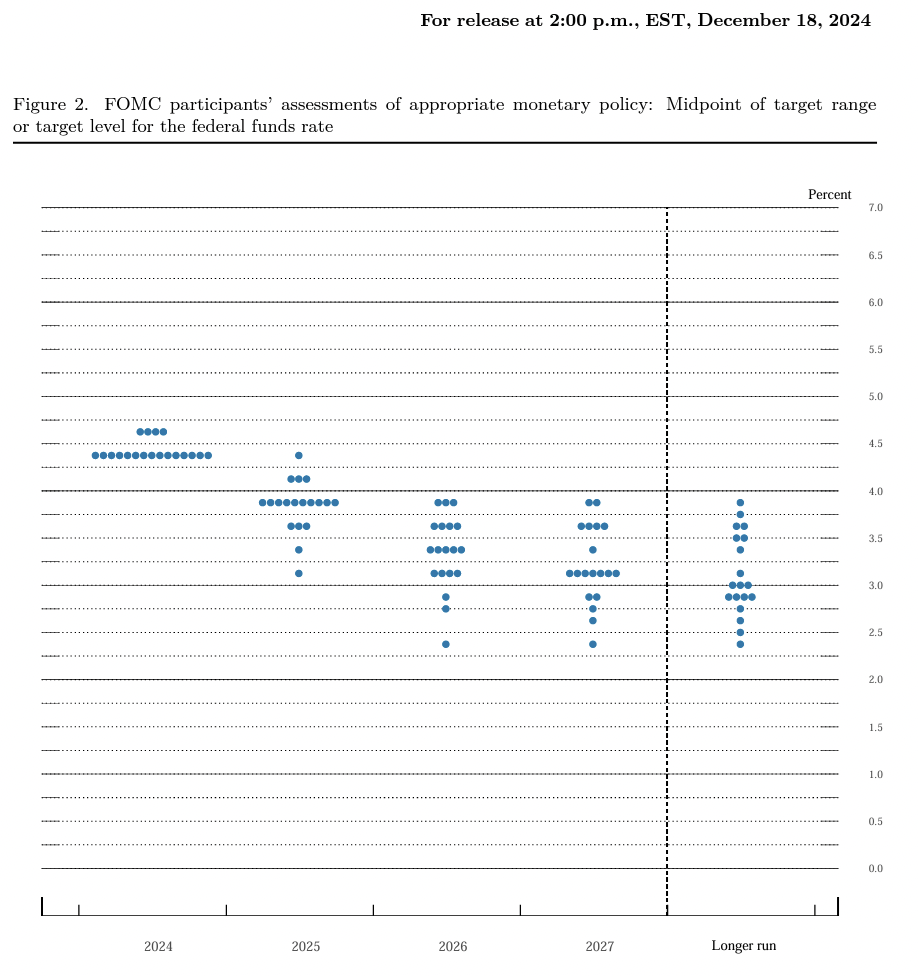
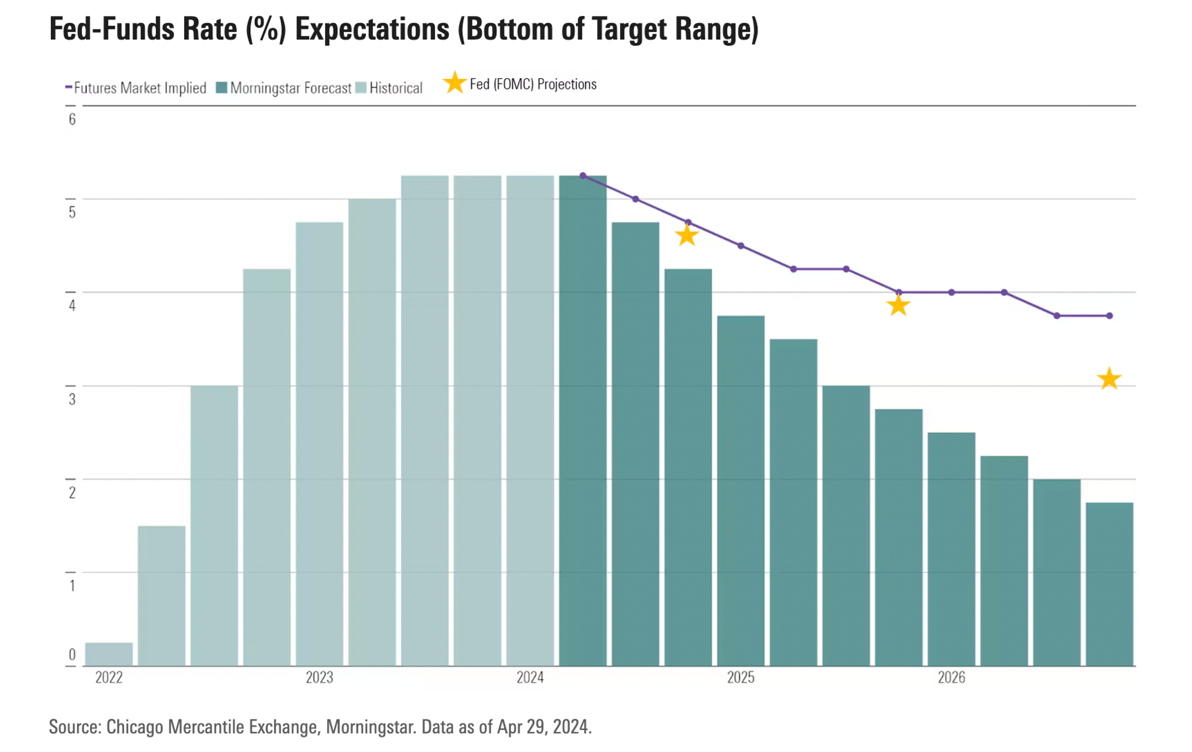
On December 18, 2024, the Federal Reserve announced another 25-basis point cut to the federal funds rate, bringing it to a range of 4.25% to 4.5% (as shown above). This marked the Fed’s third-rate reduction in 2024 as it continues its policy pivot in response to cooling inflation and slower economic growth. The move aligns with the Fed’s earlier projections, which anticipate rates potentially falling further in 2025 and 2026. 

These rate cuts reflect a broader shift toward monetary easing, aimed at stimulating economic activity as inflation trends toward the target range of 2.5-3%. For the multifamily sector, this decision carries several significant benefits: 

  1. Refinancing Opportunities: Property owners and operators can potentially take advantage of the declining interest rates to refinance existing loans, reducing debt costs and enhancing property-level cash flow. This creates immediate savings for owners and can free up capital for value-add improvements or distributions to investors.
  2. Increased Transaction Activity: Lower financing costs often result in a surge in deal flow, as both institutional and private investors capitalize on more favorable borrowing conditions. Additionally, the Federal Reserve’s rate reductions, along with their transparency on likely future rate cuts, help to alleviate the volatility that paralyzed the markets over the past few years. Multifamily properties, already considered a resilient asset class, are likely to attract additional capital seeking strong risk-adjusted returns. 
  3. Higher Potential Valuations: As borrowing costs decline, cap rates typically compress, driving higher valuations for stabilized multifamily assets. This trend may provide opportunities for owners to exit investments at premium prices or refinance at improved terms. 
  4. Attractiveness Relative to Other Asset Classes: Multifamily investments remain a standout option compared to office or retail properties, where fundamentals have lagged. With interest rates trending downward, the appeal of multifamily as an inflation hedge with potential steady cash flow becomes even stronger. 

The December rate cut also signals growing confidence that inflation is under control, paving the way for further rate reductions in 2025. Analysts forecast that additional cuts could occur as early as Q2 2025, further boosting liquidity in the lending markets and increasing investor appetite for multifamily deals. 

Sources: 

Economic projections from the December 17-18 FOMC meeting 

JPMorgan, How Interest Rate Cuts Could Impact Commercial Real Estate 


Construction Slowdown Continues 

National Construction Starts 2024

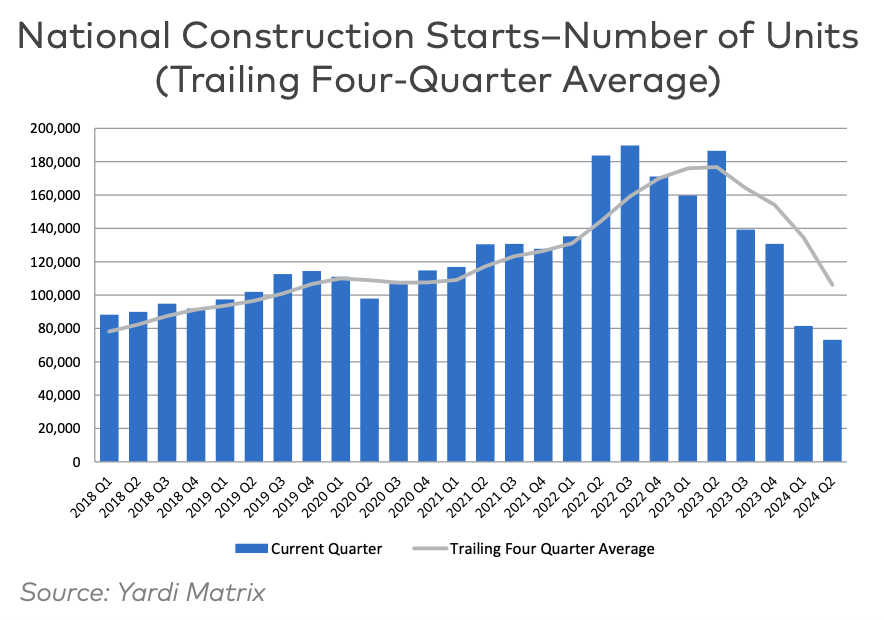
After hitting post-pandemic peaks, multifamily construction activity is experiencing a notable decline. The National Association of Home Builders (NAHB) projected a 20% drop in new multifamily starts for 2024, driven by elevated material costs, higher financing expenses due to persistent interest rate levels, and broader economic uncertainty. Developers are also contending with ongoing labor shortages, which have compounded delays in project timelines. 

Recent data suggests that the pipeline of under-construction units—estimated at approximately 900,000 units nationally as of Q4 2024—will continue to stabilize supply through late 2025. Notably, the slowdown has been more pronounced in high-barrier markets where rising land prices and stricter zoning regulations make development less feasible. Conversely, Sun Belt markets like Texas, Florida, and Arizona, while also cooling, continue to account for a substantial share of new deliveries due to sustained population growth and demand for housing. 

This moderation in construction activity could prove beneficial for rental growth prospects in 2025 and beyond. Fewer new units entering the market should help reduce supply-side pressures, particularly in regions facing record-high deliveries over the past two years. Analysts forecast that rent growth could return to the 3-4% range nationally in 2025 as existing inventory absorbs current demand. 

Additionally, multifamily construction financing remains a challenge in the current environment. The Mortgage Bankers Association (MBA) reported a 30% decrease in multifamily lending volume year-over-year in 2024, a reflection of tighter credit conditions and elevated cap rates. This dynamic has further contributed to developers pausing new projects while waiting for more favorable market conditions. 

Sources: 

(NAHB), Multifamily Housing Market Outlook Q4 2024 

Mortgage Bankers Association (MBA), Multifamily Lending Report Q4 2024 

Yardi Matrix, U.S. Multifamily Supply Forecast 2024, National Construction Starts 


The Case for Renting  

Home Purchase Sentiment

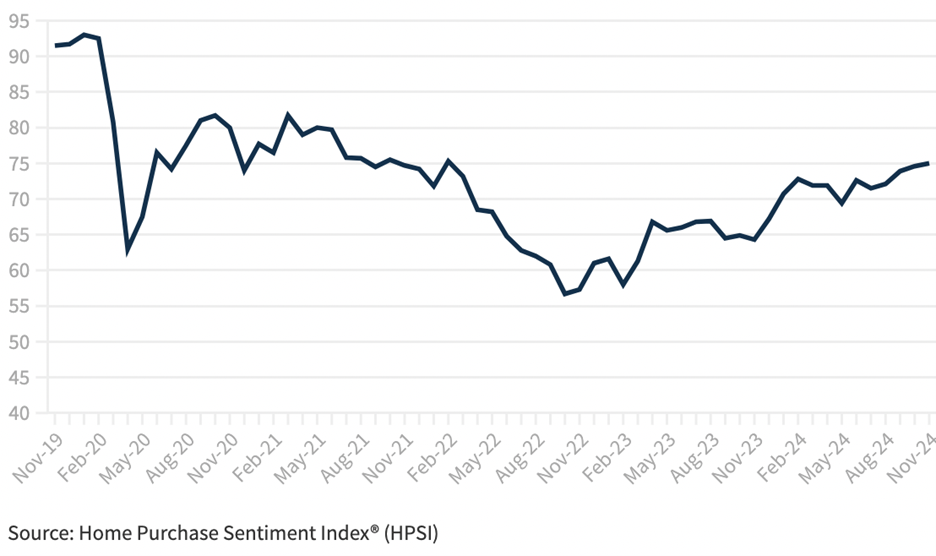
New insights from Fannie Mae’s Home Purchase Sentiment Index reveal that 77% of consumers believe now is not the right time to buy a home, reflecting a combination of elevated mortgage rates, persistently high home prices, and economic uncertainty.  

As of Q4 2024, 30-year fixed mortgage rates remain around 6-6.5%, making homeownership unattainable for many, especially first-time buyers. Additionally, housing inventory remains constrained, further inflating home prices and creating affordability pressures. 

In this environment, renting continues to be a more affordable and flexible option in most major markets. Recent data from Zillow suggests that renting is up to 40% cheaper than buying in high-cost regions such as California, New York, and Washington D.C. Millennials—who represent the largest share of renters—are driving this trend, with 27% indicating plans to rent long-term due to: 

  1. Affordability challenges: The gap between rent payments and mortgage costs continues to widen. 
  2. Flexibility: Renting offers mobility, especially appealing to younger professionals who prioritize career opportunities in different cities. 
  3. Maintenance avoidance: Rising home repair and insurance costs add to the financial burden of homeownership. 

Did you know 66% of renters say renting fits their current lifestyle more than owning a home? Source: Entrata 

Additionally, a growing preference for lifestyle amenities offered by modern multifamily developments, such as fitness centers, coworking spaces, and pet-friendly policies, further attracts renters. Our latest multifamily acquisition, Halston Waterleigh, offers these lifestyle amenities. Accredited investors can invest in this rare Class A value-add opportunity right now. Learn more HERE 

This sustained demand for rentals reinforces the stability and appeal of the multifamily sector in 2025 as new supply slows, aligning with broader economic recovery trends.  

Sources: 

Fannie Mae, Home Purchase Sentiment Index Q4 2024 

Zillow, Rent vs. Buy Affordability Report 

Yardi Matrix, U.S. Multifamily Market Insights Q4 2024 


Investor Sentiment Is Turning Optimistic 

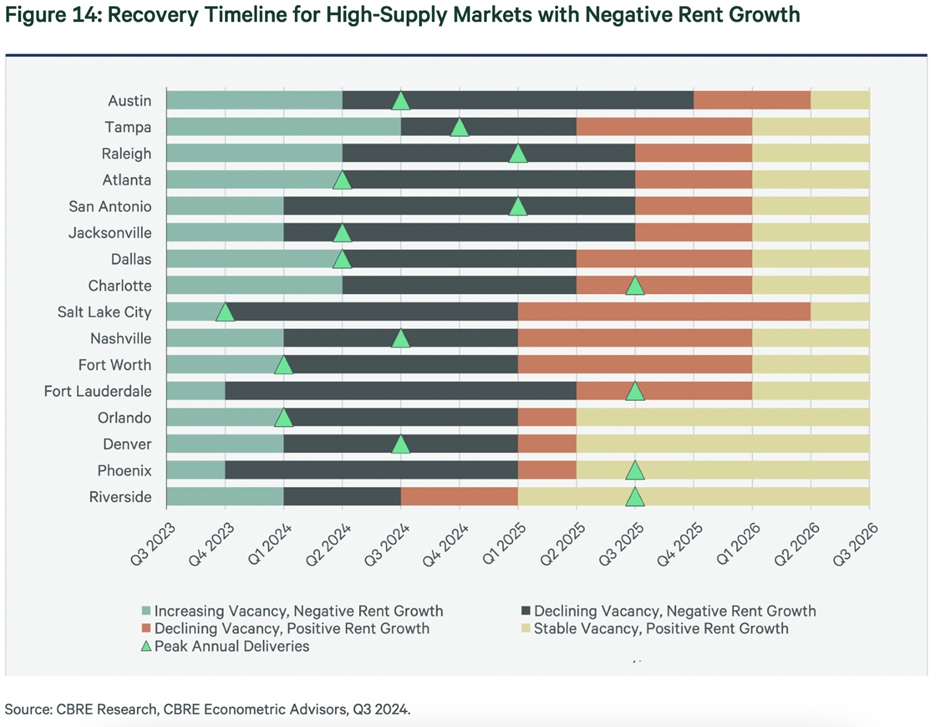
Recovery Timeline for High-Supply Markets

The U.S. multifamily market appears to have entered a phase of stabilization, with strengthening fundamentals helping to lift investor confidence, according to CBRE Econometric Advisors Q3 2024 report. 

“Sentiment has improved significantly, as many investors believe that values have bottomed,” said Kelli Carhart, Executive Managing Director of Multifamily Capital Markets at CBRE, in a statement accompanying the report. 

This shift in sentiment suggests that the market may be moving past its period of decline as key indicators begin to stabilize. 

In the multifamily sector, optimism is particularly pronounced due to higher-than-expected demand and improving affordability dynamics: 

  • Easing Inflation: Inflation levels have declined steadily in 2024, now trending at 2.5-3% annually, closer to the Federal Reserve’s long-term target. This has reduced pressure on consumer spending and supported rental affordability. 
  • Interest Rate Outlook: Expectations of a further reduction in interest rates by mid-2025 have boosted investor confidence, as lower borrowing costs would improve property valuations and enhance investment yields. The Federal Reserve’s more dovish stance has encouraged renewed capital flows into CRE, particularly multifamily assets. 
  • Robust Multifamily Demand: Multifamily continues to outperform other CRE asset classes due to strong renter demand, driven by elevated mortgage rates and affordability challenges in the single-family housing market.  

Additionally, markets with strong job growth and population inflows—such as Texas, Florida, and the Southeast—are seeing increased investor activity as they continue to benefit from demographic trends. For example, John Burns Research highlights that markets like Dallas-Fort Worth and Tampa have seen a 15-20% year-over-year increase in net rental absorption through Q4 2024. 

Investors are also becoming more strategic, targeting value-add opportunities and newer Class A properties in suburban markets where rental demand remains robust. Moreover, the relative resilience of multifamily assets compared to office and retail sectors has reinforced their appeal for institutional and private investors alike. 

Sources: 

Globest.com, CBRE Declares the Multifamily Market Has Bottomed Out 

Federal Reserve, Economic Projections Report Q4 2024 

Yardi Matrix, Multifamily Performance Metrics Q4 2024 

CBRE Research, CBRE Econometric Advisors Q3 2024 


Conclusion 

At Ashcroft Capital, we’re closely monitoring these evolving market trends to identify opportunities that align with current dynamics and investor priorities. Our focus remains on targeting well-located, stabilized multifamily assets in high-growth markets where demographic and economic factors drive sustained demand. 

By leveraging our fully vertically-integrated platform and AAA data-driven process, we aim to capitalize on opportunities that offer strong risk-adjusted returns while mitigating potential downside risks. This includes adapting to shifting capital flows, maintaining operational efficiency, and preserving value through disciplined investment strategies. 

As always, our commitment is to deliver best-in-class performance and provide our investors with opportunities that foster long-term growth and financial opportunities. 


Latest Offerings

Halston Waterleigh Learn More

  • Prime Class A asset in Orlando’s fast-growing submarket 
  • Rare Value-add: Achieving strong rent premiums without unit renovations 
  • Equity upside: Anticipated monthly or quarterly cashflow distributions with strong growth potential 
  • Acquired below replacement cost, offering immediate value 


Ashcroft Income Note Learn More

  • High Yield: 10–12% annualized promissory note, offering non-compounded, interest-only payments scheduled to be paid monthly. Includes a four-year term with two optional one-year extensions and bonus opportunities for select early or larger investors. 
  • Diversification: Capital is invested into properties controlled by Ashcroft, providing exposure to a range of assets. 
  • Risk Mitigation: Limited first-loss protection and priority in the capital stack over equity investors in affiliate-owned deals. 


Ashcroft is not an investment adviser or a broker-dealer and is not registered with the U.S Securities and Exchange Commission. The information in the presentation should not be used as the sole basis of any investment decisions, nor is it intended to be used as advice with respect to the advisability of investing in, purchasing, or selling securities, nor should it be construed as advice designed to meet the investment needs of any particular person or entity or any specific investment situation. Nothing in this presentation constitutes legal, accounting, or tax advice or individually tailored investment advice. The recipient of this presentation assumes responsibility for conducting its own due diligence and assumes full responsibility for any investment decisions.  

Any prior investment results and returns are provided for illustrative purposes only and are not necessarily indicative of potential investment results. Past performance is no guarantee of future results and should not be relied upon as an indicator of the future performance or success.  

There can be no assurance that the offerings described above will achieve its investment objectives or that investors will receive a return of their capital or the projected return on investment. Any reference to an investment’s past or potential performance is not and should not be construed as a recommendation or as a guarantee of any specific outcome or profit and should not be relied upon as an indicator of an investment opportunity’s future performance or success. 

Back to News Page

Can a Class A Property Be a Value-Add Deal?

August 3, 2024

By: Travis Watts, Director of Investor Development

Don’t Count Out a Class A Property 

There’s something I’ve been wanting to announce for a while. As an avid Limited Partner investor in the multifamily apartment space, I want to let you in on a rare opportunity happening right now.  

To start, I’d like to address a common misconception that value-add business plans only apply to older, outdated properties. In past years, this was often the case as the term “value-add” was used to describe older Class B or C properties in need of updates and unit renovations. Once the property and units get updated, rents are increased accordingly.   

Higher Risk, Higher Reward – Is This Always The Case? 

There is often higher risk associated with investing in an older Class B property compared to a newly built Class A property. A few notable risks include, but are not limited to: 

  • Risk of renovation – when turning hundreds of units, complications often arise.  
  • Risk of inflation – materials and labor increasing beyond budget or unexpectedly. 
  • Risk of delays – supply chain disruptions, contractor or permitting delays. 
  • Risk of age – Older properties often require more maintenance and upkeep. 

Imagine Buying New, Avoiding Renovations, And Still Getting Rent Premiums! 

Introducing Braxton Waterleigh – our latest acquisition. This Class A property, built in 2021 and located in Orlando, FL, offers high-end finishes and best-in-class amenities. Despite its premium Class A status, Braxton Waterleigh is a rare type of value-add opportunity. This unique blend makes it an investor’s dream, and it’s why I’m so excited about this deal. 

Upside Without the Headache – Introducing Mark-to-Market Value-Add Approach  

Adjusting the rents to align with the current market rates is referred to as ‘mark-to-market’*, and Braxton presents a unique opportunity regarding this uncaptured upside potential.  

Over the past 12 months, three new apartment communities were delivered in the nearby area. During the lease up phase of these communities, rents remained fairly flat and concessions were offered to entice new residents. As these properties are now getting close to reaching stabilized occupancy, rents are starting to increase, and concessions are being reduced.  

Regarding Braxton Waterleigh, the mark-to-market rent premiums have yet to have been captured. This allows us to acquire the property below replacement cost due to the previous softness in the area and capture current market rents as these properties stabilize. This is a multi-million-dollar benefit as unit renovations are not required for the rents to increase roughly $100 per month across 354 units.  

Maximizing Value with Ease 

And that’s the beauty of it all. We can add value to the deal without the challenges associated with the typical renovation process. To fully understand what an amazing value proposition this is, it’s important to know how commercial real estate valuations are calculated.  

Class A Property Example 

If the mark-to-market rent upside results in collecting an additional $100 per month per unit, that would increase the net operating income by $424,800 a year. As a result, the property’s value would increase by approximately $7.7 million dollars without the need to take on the added risk of renovation. 

Class B Property Example 

With a typical Class B value-add business plan requiring a full renovation scope, operators would have the following hurdles to overcome: 

  • ≈ $3,540,000 needed to renovate 354 units, assuming a $10,000 per unit budget. 
  • In addition to upgrading units, further renovations would likely be required on the property such as updating the clubhouse, amenities, landscaping, and any deferred maintenance. This could add millions more depending on the property’s needs.  
  • The turnaround time for a business plan like this would likely take several years. 
  • Rent increases would not occur as quickly as each unit would first need to be renovated, compared to the mark-to-market value-add strategy. 

Braxton Waterleigh is That Deal 

Braxton Waterleigh represents a rare opportunity for value-add investors. Offering the combination of Class A luxury and upside potential, but without the usual renovation risks with older Class B or C properties.  

I invite you to book a call with a member of our Investor Relations Team to learn more. Additionally, you can view the investment overview by visiting our Current Offerings page.  

*The information presented is for illustrative purposes only and are not necessarily indicative of potential investment results, nor does not constitute an exhaustive explanation of the investment process, investment strategies or risk management. 


travis@ashcroftcapital.com

Back to News Page

The Orlando Real Estate Market: A Prime Time for Multifamily

July 25, 2024

By: Travis Watts, Director of Investor Development

The Orlando Real Estate Market

Tourism Isn’t the Only Factor Driving the Orlando Real Estate Market 

Orlando, Florida is often associated with its world-famous theme parks and vibrant tourism industry. However, this bustling city has much more to offer to multifamily investors. 

While the leisure and hospitality sectors remain robust, the city is experiencing rapid growth in many other industries, including healthcare, aviation and defense, aerospace, financial services, and advanced manufacturing. These sectors have been contributing to the city’s economic health and provide diversified employment options for renters, that in turn, benefit apartment owners. 


A Hub for Economic Expansion 

Orlando’s unemployment rate currently stands at 2.9%, below the national average of 4.1%. The city is also projected to see an annual job growth rate of 1.1% over the next five years, nearly double the national average of 0.6%. Did you know Orlando is expected to add approximately 1,500 people per week for the next 11 years? By 2035, Orlando’s population is projected to reach about 5.2 million people, according to Oxford Economics. 

In addition to the rapid expansion happening in Orlando, Florida in general, has seen significant growth in the number of companies calling the Sunshine State home. According to a recent Hire A Helper study, Florida saw an 86% net gain of corporations that moved their headquarters there in 2023, the highest net gain of any state. This rapid population increase places significant demand on multifamily housing as millions of Americans continue to be priced out of the single-family housing market and are relocating for job opportunities, warmer weather, and a tax-friendly environment.  


Orlando’s Job Market Thrives on Industry Diversity 

Healthcare and Research 

Healthcare has been a leading employment sector for years in Florida. Since the onset of the pandemic, the healthcare sector has proven to be one of the most economically resilient among renters, benefiting apartment owners. Orlando is home to numerous hospitals, clinics, and specialized healthcare facilities, providing a wide range of services and high-paying employment opportunities for residents. The healthcare sector’s growth is expected to continue, fueled by the increasing demand for medical services (most notably retirees) and the presence of leading healthcare providers in the area. 

Aviation and Defense 

Orlando’s proximity to the Space Coast and robust infrastructure have created a hub for aviation and defense industries. The city hosts several major defense contractors and aerospace companies (i.e. Lockheed Martin and Boeing) offering even more white-collar jobs and economic diversity.  Florida’s aerospace workforce is currently 41,800+ people strong with over 640 establishments in the sector. 

Financial Services and Advanced Manufacturing 

The financial services sector in Orlando is also on the rise, attracting banks, investment firms, and other financial institutions, many of which have relocated from New York over the past four years. Additionally, advanced manufacturing is on the rise, with companies specializing in high-tech production and innovation.

There are many other strong innovation hubs throughout the city. Right at the center is a new development, the Creative Village. Spanning 68 acres, Creative Village will be one of the largest transit-oriented developments in the Southeast and will build upon Orlando’s deep digital roots and success. NeoCity is another technology district that houses the world’s first industry-led smart sensor consortium, BRIDG. Plans are currently in the works for this hub to support a $15 million STEM-focused high school to drive future tech growth. 


Navigating the Orlando Real Estate Market 

Did you know Orlando ranked among the top markets nationwide for multi-family sales volume, with $1.7 billion in sales activity over the past year? New construction in Orlando has slowed significantly due to rising interest rates and inflation. The number of new permits issued for multi-family housing has dropped by approximately 45% compared to the peak in 2021/2022. This reduction in new supply anticipated to hit the market in the coming years, combined with the city’s growing population, creates a favorable investment environment for existing multi-family properties. 

Investing in Orlando’s multi-family market in 2024 offers a unique opportunity to capitalize on the city’s outperforming strength and growth potential. Properties in desirable locations present attractive investment options as valuations are currently down from their peak of 2021/2022 due to rising interest rates. Particularly Orlando submarkets such as Horizon West are benefiting from proximity to major employers, top-rated schools, and high-paying employment options. 


The Investment Opportunity 

Our latest acquisition, Braxton Waterleigh, is located in Horizon West, one of the fastest-growing master-planned communities in the country. This Class A, luxury property was built in 2021 and consists of 354 units.  

We are purchasing Braxton Waterleigh at a significant discount relative to recent sales comps. More notably, we are buying nearly 10% below replacement cost, providing an outstanding basis given that new construction completions in Orlando are projected to decrease by 57% in 2026 boosting demand for existing Class-A luxury apartments. 

Business Plan and Projections 

Our business plan for Braxton Waterleigh includes bringing discounted rents to the market level, further enhancing the amenities, and implementing our high-end luxury Halston brand finishes. The current owners reduced rents to compete with new construction lease-ups over the past three years. We are acquiring this property as lease-ups are nearing completion. As we enter the summer of 2024, surrounding properties, as well as Braxton, are nearing full occupancy, which has presented an opportunity to reduce concessions and lift the rents to the market level. 

We are securing a fixed-rate agency loan at a competitive rate of 5.55% to mitigate risk for investors and we project a five-year hold period. Braxton Waterleigh is cash flow positive and offers investors significant equity upside potential as markets are projected to improve and demand is forecasted to rise. 


Capitalize on the Orlando Real Estate Market in 2024 

Orlando, Florida saw the 4th largest population gain in the country over the past year and is recognized by the Wall Street Journal as a “Hot Spot for Job Growth.” The current capital market conditions present a unique buying opportunity for investors this year, as discounted valuations are likely to be short-lived. With interest rates expected to decline in the coming years, valuations in the commercial real estate market are poised to rise. For those ready to invest, Orlando offers unparalleled potential and Braxton Waterleigh presents a unique opportunity to invest in a Class A trophy asset at a significant discount.  

To learn more, we invite you to book a call with an Investor Relations representative. This complimentary, no-pressure call will equip you with the knowledge and information needed to make an informed decision. You can access additional information and review the investment overview by visiting www.investbraxton.com.     

travis@ashcroftcapital.com

Back to News Page

Family Finances: Fundamentals of Generational Wealth

July 11, 2024

By: Danielle Jackson, Investor Relations, Senior Manager

Family Finances: Generational Wealth

Family Finances Matter 

It takes money to make money! We’ve all heard this saying, and while true, it’s not 100 percent accurate.  

Making money takes time, effort, knowledge, and capital that is converted into income. But the wealthy don’t just expect their wealth to grow; they plan for the next generation to maintain and build it.   

Generational wealth is a method of securing financial wellness to help safeguard the financial wellness of our children, perhaps our grandchildren, and so on. The goal is to grow assets and income over time, putting each generation in a better financial position than the previous one.  

However, 70 percent of affluent families lose their wealth by the next generation and 90 percent lose it the following generation, making investors unable to create a lasting legacy.[1]   

Don’t let that data scare you – there are ways others have created generational wealth that lasts well beyond their children and grandchildren.   


Consider Investing and Diversify  

Generational wealth is ideally cultivated in a way that creates generous upside potential but with capital preservation. There are many ways investors may approach that challenge.  

When investing in the financial markets, one of the most common strategies investors use to achieve this goal is building a diversified investment portfolio. Overexposure to any single stock, investment type, or sector can significantly increase risks.  

While the concept of diversification is well known, some investors may fail to apply this principle to the overall mix of assets within their portfolio. Due to 2022’s inflation, geopolitical tensions, supply chain issues, etc., Wall Street saw the largest annual percentage drop for the three main stock indexes since 2008.[2]  

Investors seeking strategies to diversify their portfolios, hedge against inflation and offset risk may want to consider real estate.[3] Real estate can offer a reliable, tangible asset with potential for consistent cash flow and is not directly subject to short-term market volatility. Additionally, historical trends show that real estate values have often outpaced inflation, making real estate an attractive option for those looking to build long-term generational wealth.[4]   

By investing in different types of assets, you aim to mitigate your overall exposure to any one type of risk. The goal is to create a balanced portfolio with both growth and income-producing assets, maximizing returns while reducing risk.   


Financial Literacy Sustains Generational Wealth 

Financial literacy is the skills, knowledge, and tools that allow people to make sound financial decisions. It extends beyond just knowing your finances and includes being an active participant in financial planning, while maintaining the ability to manage emotional and psychological factors that could influence your decision-making.  

Many people who inherit wealth may not be educated on the importance of financial knowledge. As a result, they may delay acting in their investment portfolio out of fear of the unknown. 

Why is it important? When it comes to building generational wealth, financial literacy is key. Only 22 percent of U.S. high school students have access to personal finance courses.[5]  

Additionally, a recent annual survey found that only 52 percent of U.S. adults are “financially literate,” and less than 37 percent understood “comprehending risk” (i.e., understanding uncertain financial outcomes).[6]  

We all have unique values, goals, and dreams that motivate us. Accessing and understanding the financial information needed to make those dreams happen can be extremely empowering.  

The good news is that you can start investing in your children’s and grandchildren’s financial education now. Ensure they know the basics of budgeting, savings, retirement, and investing, and give them the tools they need to protect their long-term wealth.   

Having open conversations about money and investing, including both your methodical decisions and not-so-logical decisions, can help your family learn and make better choices in the future. As an investor, it is inevitable that you will experience a loss.  

Rather than dismissing those losses, view them as an opportunity to educate your family to help them avoid making those same mistakes down the road. Teaching your family how to save, spend, and give will help develop financial responsibility.  

Involving your children in the financial planning process is critical to helping them understand the importance of small actions and their potential major impacts on future financial outcomes.  


Secure Your Family Finances: Ashcroft Capital’s Multifamily Investments 

Ashcroft Capital is headquartered in New York and has a team of real estate professionals that focus on capital preservation and wealth generation. Due to our focus and expertise, over 4,000 investors have trusted us with their capital.   

Drawing upon the experiences of our over 300 employees, our team knows how to maximize the returns on our properties, create superior living spaces for our tenants, and allow our investors to realize their financial goals.  

Our investment model is tailored for investors who want to enjoy all the benefits of owning multifamily real estate without the headaches of being a landlord. Moreover, we are committed to supporting your investment journey by providing resources for navigating the real estate investment industry and syndication throughout 2024 and beyond.   

If you would like to learn more about investing in multifamily assets, or our current investment opportunities, schedule a call with Investor Relations today. 

danielle@ashcroftcapital.com

Back to News Page

Investing in Commercial Real Estate vs Single-Family

July 5, 2024

By: Travis Watts, Director of Investor Development

Passive Income Lifestyle Explores Investing in Commercial Real Estate Investments vs Single-Family

The Passive Income Lifestyle series is all about you, the passive income investor,  discussing mindset, strategies, philosophies, stories, and more.  

In this episode, Travis explores the fundamental differences between investing in commercial real estate and single-family. Investing in real estate offers numerous opportunities, each with its own set of benefits and challenges.  

Whether you’re a seasoned investor or just starting, understanding these differences is important for choosing the right investment strategy that aligns with your financial goals. 


The Basics: Commercial Real Estate vs Single-Family

Let’s define single-family and commercial real estate: 

  • Single-Family Real Estate typically refers to standalone residential homes intended for one family. These can be primary residences or investment properties rented out to tenants. 
  • Commercial Real Estate (CRE) encompasses a broader range of properties including multifamily apartments, offices, retail spaces, warehouses, and more. These properties are primarily used for business purposes and are intended to generate income. 


Shared Advantages of Single-Family and Commercial Properties  

Despite their differences, single-family and commercial properties share several common benefits for investors. Both can provide passive income, appreciate, offer tax advantages, and typically involve some level of leverage or debt, which can amplify returns but also introduce risk. 


Challenges in Single-Family Real Estate 

While single-family properties provide investors with more control over their investments, they require active management and involvement. From selecting tenants to maintaining the property, these tasks can turn a passive investment into an active job, especially without the help of a property management company.  


Advantages of Investing in Commercial Real Estate

Investing in commercial real estate can provide significant economies of scale. For example, renovating multiple units at once can lead to significant cost savings.  

These investments often involve syndications, where investors pool resources to purchase larger properties, reducing individual risk and management responsibility. Moreover, commercial properties usually have professional management teams, which can mean a more passive investment experience for individual investors.  

1. Specialization  

Commercial real estate is a broad category that includes not just residential units like apartments but also industrial, office, and retail spaces, among others. This diversity allows investors to specialize in niches that align with their investment strategy and market conditions. 

2. Financing  

Commercial properties typically involve shorter loan durations (five to seven years) compared to the 15 to 30-year mortgages common in single-family real estate. This difference can affect cash flow and refinancing options. 

3. Value 

The value of commercial properties is largely determined by the income they generate, which can provide a more stable and predictable basis for valuation. In contrast, single-family homes are usually valued based on comparable sales, which can be more volatile and influenced by external market factors. 


Making the Choice: Commercial Real Estate vs Single-Family

Choosing between single-family and commercial real estate investment depends largely on an investor’s financial goals, risk tolerance, and level of involvement desired. Each type offers distinct advantages and comes with its own set of challenges. 

The key to successful real estate investing lies in aligning your investment choices with your personal goals and market conditions. Whether you’re drawn to the hands-on approach of single-family homes or the larger-scale, diversified opportunities in commercial real estate, both paths offer valuable experiences and the potential for substantial financial returns. 

For those looking to expand their knowledge, additional episodes of the Passive Income Lifestyle series can be found on the Ashcroft Capital YouTube channel 

travis@ashcroftcapital.com

Back to News Page

Syndication in Multifamily Real Estate: Key Questions for Investors

July 2, 2024

By: Travis Watts, Director of Investor Development

Syndication in Multifamily Real Estate Key Questions

Evaluating Syndication in Multifamily Real Estate 

Before diving into the top questions to ask a syndication partner, it’s essential to address some critical questions about your own investment goals and preferences. Understanding your personal investment objectives is vital not only for selecting a syndication partner whose goals align with yours but also for determining if syndication in multifamily real estate is suitable for you.

1. What Are Your Investment Objectives?

  • Cash Flow 
  • Growth 
  • Tax Benefits 
  • Wealth Preservation 

Clearly defining your investment objectives is the first step. This helps ensure that your goals align with those of the syndication partner and makes it easier to identify the right investment opportunities.

2. What is Your Investment Timeframe?

Consider whether you value liquidity or if you’re comfortable locking up your capital for extended periods. Some syndication operators only plan to hold a property for a couple of years. Others may not project a timeframe to sell; therefore, you may be invested for a decade or longer. Knowing your ideal investment timeframe in advance can help you select the right syndication opportunities.

3. What is Your Risk Tolerance?

Evaluate whether you are risk-averse or open to higher-risk opportunities with potentially higher returns. Your risk tolerance will significantly influence the types of deals you should consider.  

For example, an opportunistic investment may entail a higher risk profile compared to investing in a value-add property with high occupancy that offers immediate cash flow. You can learn more about these investment types on our YouTube Channel 


Questions to Ask a Potential Syndication Partner 

Understanding your own objectives is just one part of the equation. It’s equally important to ask the right questions when it comes to vetting a syndication partner. Below are three questions to consider. 

1. What is Your Exit Strategy?

This question provides insight into your syndication partner’s experience, investment objectives, and business plan. At Ashcroft Capital, our focus is on creating value through well-defined exit strategies. Our track record shows a consistent pattern of identifying the right time to exit investments, ensuring optimal returns for our investors.  

Our target hold period is five years for single assets and seven years for our funds. Historically, it takes about three years for us to complete a value-add business plan, so a projected 5–7-year timeframe allows for added flexibility to sell at the most opportune time.  

2. What is Your Investment Strategy?

Ask why the syndication partner is pursuing a core, core-plus, value-add, or opportunistic strategy. Their rationale should reflect their experience, infrastructure, and available resources. A detailed explanation indicates confidence and preparedness. 

At Ashcroft Capital, we specialize in value-add investment strategies. The business plan is to acquire stabilized, cash flowing properties, enhance them through strategic renovations and operational improvements, and ultimately increase their value over time.  

This approach has allowed us to deliver double-digit net returns to our investors while improving the living conditions for our residents in the process. You can view a video example of one of our projects on our YouTube Channel 

3. Does the Partner’s Compensation Structure Align with Your Interests?

Be wary of partners who have no personal investment at stake but expect to get paid regardless of the investment’s performance. Ask if they get paid even if you lose money. Seek out partners who prioritize investor compensation and align their success with yours. 

At Ashcroft Capital, we believe in aligning our interests with our investors. That’s why our General Partners co-invest as LPs in every deal. At a minimum, our GPs invest $100,000 in each deal, but in many cases, the amount is much higher. We also offer our investors a “coupon” on preferred return to ensure LPs are paid before the GPs.  

Additionally, our asset management fees are not collected until our investors have been paid their full coupon. Our compensation structure is designed to reward performance, ensuring that we succeed only when our investors do. 


Is Syndication in Multifamily Real Estate Right for You? 

Though every investment entails a level of risk, much of this can be mitigated by investing with the right partners or managers. For syndication in multifamily real estate, the experience, defined exit strategy, clear investment approach, and precise business plan of your partner are crucial for success. 

Our mission is to create exceptional investment opportunities through strategic acquisitions, diligent in-house property management, and a commitment to transparency and integrity. By asking the right questions—both of yourself and your potential partners—you can significantly enhance your ability to vet your next syndication investment effectively. 

Discover the power of hands-off real estate investing. To learn more, we invite you to book a call with an Investor Relations representative. This complimentary, no-pressure call will equip you with the knowledge and information needed to make an informed decision.  

travis@ashcroftcapital.com

Back to News Page

Major Players Bet Billions: Reinforcing Multifamily Real Estate

June 28, 2024

By: Travis Watts, Director of Investor Development

There is a significant trend unfolding this year, particularly in the residential real estate sector. Investors are channeling billions into this market, sparking discussions, and raising significant questions about the future of real estate.[1] 

This surge in interest is not random but a calculated move by some of the biggest names in the industry, signaling potentially lucrative opportunities for those ready to dive in. 


A Massive Signal for Multifamily Real Estate? 

One overarching question captivating the real estate community is whether the recent increase in investment volume is a cue for jumping back into the commercial multifamily space.  This speculation gained momentum following a landmark announcement in April 2024 by Blackstone, the World’s largest owner of commercial real estate.   

The firm announced it will acquire Apartment Income REIT, ticker symbol AIRC, for nearly $10 billion. Furthermore, Blackstone plans to invest more than $400 million to improve the existing communities in the portfolio and may invest additional capital to fund further growth, underscoring a strong belief in the future of multifamily residential real estate.[2]


Blackstone’s Strategic Real Estate Moves 

In May 2024, Blackstone made another significant move to expand its residential footprint by 38,000 homes as it privatized Tricon Residential, ticker symbol TCN in a deal valued at $3.5 billion. Blackstone’s position near the top of the real estate food chain is evident through its aggressive acquisition strategy in both the multifamily and residential single-family sectors.[3] 

These moves place Blackstone at the forefront of a robust acquisition strategy, straddling both multifamily and single-family sectors. However, this aggressive approach is only one example of the broader trend of capital flowing into residential real estate this year. 


Other Major Players in the Real Estate Game 

This is not an isolated trend; a wide array of institutional players are also making substantial moves in residential real estate. For a broader perspective, let’s look back at the fourth quarter of 2023. According to Redfin, investors purchased 26% of the country’s most affordable homes in Q4 2023 – the highest share on record.  

High-profile investors like Jeff Bezos, founder of Amazon, have also entered the fray. Bezos recently backed a real estate startup that’s buying single-family homes across the nation and allowing retail investors to partner alongside.[4] Additionally, financial titan JP Morgan has formed a joint venture to invest $1 billion into rental homes nationwide.[5]  

These recent acquisitions have many questioning whether this signals a market bottom and if we can expect upward momentum from here. This large influx of institutional capital into residential real estate is certainly a vote of confidence. 


A Prime Time for Multifamily Real Estate 

It is evident that some of the biggest names in the industry are jumping into residential real estate nationwide, both in the multifamily and single-family sectors. The billions of dollars invested are helping stabilize the market, and are opening doors for retail investors who are ready to jump in.  

As these market dynamics continue to evolve, the recent actions of institutional investors serve as a leading indicator for the sector’s direction. Staying informed and agile will be key to capitalizing on emerging opportunities.  

For accredited investors in a position to deploy capital, this could be an opportune moment to consider multifamily real estate. If you are interested in learning more about our current investment opportunities, please schedule a call with us or visit www.ashcroftcapital.com 

travis@ashcroftcapital.com

Back to News Page

Stop Chasing High Yield Investments: This Is a Better Strategy

June 24, 2024

By: Travis Watts, Director of Investor Development

The Surprising Truth About High Yield Investments 

Isn’t investing all about yield? Don’t you want the highest return on your money? 

You might be surprised to learn that chasing high yield investments is not always the best strategy for long-term success. It took me many years to learn this, but now I want to share why a different approach can be more beneficial for long-term success. 


A Unique Investment Approach 

In my early years of investing, achieving 30%+ annualized returns on my investments was not uncommon. But today, I earn more money (in terms of dollars) despite having lower returns. This shift in strategy came after a mentor explained his unique approach to me. 

My mentor, who sold a company and became a full-time investor in the 1990’s, allocates 40% of his portfolio today to assets producing 3-4% annual returns. Initially, his strategy to sideline high yield investments seemed like a poor choice to me. However, his rationale was based on his substantial net worth and risk tolerance. 


Understanding the Math 

At the time of our discussion, my mentor’s net worth was around $80 million. By investing 40% in low-risk, tax-free municipal bonds yielding 3-4%, he secures nearly $1,000,000 a year in passive income. He discovered how much is “enough” and doesn’t need to take high risks with this portion of his portfolio. Even if the remaining 60% of his portfolio went into failed deals, he could still live comfortably. This perspective on risk management was enlightening and led me to reassess my own investment strategy. 


Moving Away from High Yield Investments 

In my earlier years, I enjoyed the results that were achievable from high yield investments due to a rising market and an active real estate strategy. However, these strategies exposed me to significant risk in the event of downturns. As I matured, I began reducing risk, targeting lower yields of 6-10% annualized. While these yields are significantly lower than the early years of investing, my income has increased due to having a larger investment base. 

Consider these scenarios: 

  • With $100,000 invested at 30%, you earn $30,000 annually. 
  • With $1,000,000 invested at 10%, you earn $100,000 annually. 

The latter scenario illustrates how lower yields on a larger investment can generate more substantial income while taking on less risk. 


Evaluating Your Risk Profile for Smarter Investment Decisions 

  1. Risk Profile: Understand how much risk you are willing to take. 
  2. Down Market Performance: Evaluate how your investments might perform during downturns. 
  3. Defining “Enough”: Determine how much income is sufficient for your lifestyle needs. 

For me, prioritizing consistent and stable income with a low-risk profile is more beneficial and sustainable over the long-term. This approach reduces the anxiety of market shifts, knowing these are inevitable. I encourage you to consider this philosophy and evaluate your current investing approach.  

If you would like to learn more about investing in multifamily assets, or our current investment opportunitiesschedule a call with Investor Relations today.

Find additional Passive Income Lifestyle episodes on the Ashcroft Capital YouTube channel. 

As always, reach out with any questions. I’m happy to be a resource.  

travis@ashcroftcapital.com

Back to News Page

Unveiling Braxton Waterleigh: A Luxury Class A Property in Orlando

June 13, 2024

By: Travis Watts, Director of Investor Development

Braxton Waterleigh: Where Luxury Living Meets Opportunity 

Ashcroft Capital presents a unique investment opportunity that combines luxury living with strategic market positioning. Located in one of the top three fastest growing master-planned communities in the country, Braxton Waterleigh is a premier 354-unit luxury asset located in Winter Garden, Florida, a submarket of Orlando.

Built in 2021 by Fortune 500 homebuilder D.R. Horton, this property offers a unique blend of elegance, community appeal, and investment potential. Braxton Waterleigh stands as a prime example of a Class A property, featuring high-end amenities, open floor plans, and spacious 9ft ceilings.

The property’s vicinity boasts a 72% white-collar workforce, with average incomes around $90,000 within a one-mile radius, and $115,000 among property residents. This affluent demographic, along with access to A-rated schools and a rapidly expanding job sector, makes Braxton Waterleigh highly attractive to investors. 


Market Analysis: Orlando’s Diverse Economy Fuels Apartment Demand  

Orlando is known globally for its tourism industry. It is home to Walt Disney World and Universal Orlando, which support over 100,000 jobs and attract more than 75 million tourists every year. Beyond tourism, Orlando’s robust economy includes thriving sectors such as healthcare, aviation and defense, aerospace, financial services, and advanced manufacturing. These diverse industries drive strong job growth and high salaries, fueling apartment demand.  


Submarket Analysis:  Horizon West’s Master-Planned Oasis 

Braxton Waterleigh is nestled in Horizon West, a master-planned community that has seen population growth of 130% since 2010. Horizon West is not just another suburban development; it is a dynamic community spanning over 22,000 acres (about the area of Manhattan) designed for family, entertainment, luxury, employment, and convenience.  

The community is designed to support the growing population, as residents enjoy easy access to major roads, a variety of retail and entertainment options, and access to newly constructed A-rated schools located in the #2 ranked school district in Orange County. The area is also home to significant developments like the Hamlin Town Center and Flamingo Crossings Town Center, which enhance the community’s convenience and appeal.  


Mark-to-Market Opportunity 

Over the past few years, three new apartment communities have been delivered in the immediate area surrounding Braxton Waterleigh. During the lease-up phase of these communities, rents remained flat as concessions were offered to new residents in order to help stabilize the properties. These properties are now achieving high occupancy levels, and rents are beginning to increase in the market accordingly. 

Given the current owners’ need to sell due to their maturing debt, coupled with below-market rents, Ashcroft is acquiring Braxton Waterleigh at a nearly 23% discount. Furthermore, completions in Orlando are expected to fall by 57% in 2026 which is projected to increase the demand for Class-A apartments, including Braxton Waterleigh. 


Braxton Waterleigh Property Features and Amenities 

Braxton Waterleigh offers a variety of best-in-class amenities that boost its appeal to potential residents. These include a heated saltwater pool, first-class fitness center, car wash station, BBQ grilling areas, a dog park, parcel lockers, sand volleyball court, business center, premium lounge areas, and units that offer oversized floor plans. This combination of high-end amenities and well-designed living spaces positions Braxton Waterleigh as a premier residential option in the area. 


Strategic Acquisition and Market Positioning 

The acquisition of Braxton Waterleigh is strategically timed to take advantage of current market conditions. The property is being purchased at a ~10% discount to replacement cost and at a cap rate of 5.5%, which is more competitive compared to recent transactions and comps in the area. Current market dynamics and a pre-existing relationship with the seller have created an off-market opportunity for Ashcroft Capital to acquire this asset with favorable terms. 


The Business Plan at Braxton Waterleigh 

Though the property currently offers luxury finishes and a best-in-class amenity package, we will continue to further enhance the common areas and amenities to elevate the overall appeal of the property. Along with rebranding to Ashcroft Capital’s “Halston” brand, the business plan for Braxton Waterleigh includes several strategic initiatives to enhance the property: 

  • Enhanced Unit Interiors: Implementing tech packages that provide smart locks, smart thermostats, smart lights, and leak detection systems, and replacing carpet in living areas on the 2nd and 3rd floors with upgraded faux wood flooring. 
  • Exterior and Common Area Improvements: Elevating amenities and the common areas, addressing minor deferred maintenance, and improving curb appeal and signage. 
  • Operational Improvements: Tightening operations and improving resident retention. Adjusting rents to market level and reducing concessions and bad debt on the property. 

These projects will be overseen by Birchstone Residential and Birchstone Construction, Ashcroft Capital’s in-house property management and construction team, to ensure a seamless and effective implementation. 


Financial Structuring for Investors 

To mitigate risk, Ashcroft Capital will secure a 5-year fixed-rate agency loan with an LTV of approximately 65-70%. This loan is anticipated to include 5 years of interest-only payments at an all-in interest rate of approximately 5.55%. This strategic debt structuring aligns with the property’s anticipated hold period and reduces the risk of interest rate fluctuations throughout the hold period. 


Looking Ahead: The Exit Strategy  

Ashcroft Capital plans to seek a disposition of Braxton Waterleigh in approximately five years.  The goal is to capitalize on the property’s enhanced value resulting from the successful implementation of the business plan, market appreciation, and stabilized rental income.  


Join the Journey: Braxton Waterleigh Offers Strategic Advantage  

As Orlando continues to grow and diversify, Braxton Waterleigh is poised to capitalize on current and upcoming trends, as a strategic acquisition by Ashcroft Capital. 

The property offers investors a strong resident appeal, mark-to-market upside potential, and strategic positioning within one of the nation’s fastest-growing communities in the United States. Investing in Braxton Waterleigh is not just about owning a piece of luxury real estate; it is about joining a dynamic community of investors alongside a best-in-class operator to enhance the lives of residents and support the ever-growing demand for rental housing in Central Florida.   

To learn more, please visit www.investbraxton.com or schedule a call with our Investor Relations Team today.   


travis@ashcroftcapital.com

Back to News Page

WSU Basketball Coach Embodies the Ashcroft Team Spirit

June 12, 2024

Investor Feature - Jim Shaw

“I feel like I’m on a team, but I’m a silent partner––and that is important to me.” 


As the associate head coach for men’s basketball at Washington State University, Jim Shaw knows what it means to invest in the future. For more than thirty years, he has guided and mentored young men on and off the court. His demanding job, constant travel, and reflection on his ideal retirement have all inspired Jim to invest in his own future.  


Putting Landlord Duties on the Bench  

“My dad was a landowner and so I’ve been around investment,” says Jim of his early exposure to earning multiple streams of income. “As I progressed in my career, I looked for ways to set up passive income. I started out with rental homes, which worked really well because we bought them at a time when the housing market had almost collapsed in 2008. But with my full-time career, I discovered that it’s hard to be a long-distance landlord.” 

Luckily, Jim’s son-in-law introduced him to the concept of real estate syndication, opening a new potential for passive income that is truly hands-off. “I’ve slowly weaned my way out of the landlord game and into this one,” he explains.

After bonding with Joe Fairless over their ties to The Big 12, and conducting some independent research, Jim decided to give Ashcroft a shot. He’s now been with Ashcroft for over five years.   

Jim Shaw Washington State University


Jim’s Investment Playbook  

In addition to looking for five percent or greater returns, Jim employs a ‘worst-case-scenario’ rule of thumb for investing. “I want to make sure that I can afford the worst-case scenario. In this case, people are always going to need a place to live. Interest rates going up affects everybody and everything; but at the same time, the rental market should stay strong because less people can buy homes. Evaluating the worst case is great because everybody feels good when the best-case scenario happens instead.” 

Jim is hoping to stack up some of those best-case scenarios to pad his future retirement. “What I’d like in the long-term is plenty of discretionary income so that when I retire, I’m not just relying on social security; I should have two or three other income streams.” And he’s worked out a clever strategy to maximize the benefits of his role until he gets there. “Once you hit age 50 and you’re a state employee, there are a lot of ways you can pre-tax your dollars,” says Jim.

“I max everything––then I use the cushion from Ashcroft to make sure I have enough monthly income.”  

Jim Shaw President


Finding Balance Amidst COVID and the Current Market 

A stellar coach and strategist, Jim is quickly adapts to change and thinking one step ahead. “I made the decision to sell my rental properties based on the circumstances surrounding the pandemic. I like balance in most areas, and it became really unbalanced to be a landlord because you just didn’t have a lot of levers to continue your income stream during the crisis. And I don’t have time right now to really focus on my investments, so that made the decision to sell simpler.”  

“With Ashcroft, I like the fact that I don’t have to put a tremendous amount of time into it. I still have a very demanding career. I like being the silent partner and letting the experts be the experts.”  

In a tumultuous post-COVID world, Jim trusts Ashcroft to navigate the changing tides and still deliver. “There are challenges in the investment world right now with interest rates, but the reality (in my opinion) is interest rates probably won’t come back down. I think they’re getting close to leveling out. We got unbalanced for a while: zero is unbalanced as it essentially gives money away. I think ultimately, they’ve come back to a balance point. From a strategy standpoint, I’ll let the experts figure out what the new normal is going to be and how we can still achieve our goals financially.”   

Jim Shaw Washington


Taking Lessons from the Court into Investing  

Having the Ashcroft team on hand to offer regular communication, a solid action plan, and a high level of return gives Jim the space to focus on the court. In fact, his role as a coach reminds Jim of what he likes most about Ashcroft. “In coaching you try to eliminate mistakes and maximize what you control. You’re dealing with 18 to 22-year olds. If you can get them to have a consistent attitude and a consistent work ethic, then you can form a unified personality and common goals,” Jim explains.

“With Ashcroft, I feel like I’m on a team, but I’m a silent partner––and that is important to me. Let the experts be the experts and try to have a good attitude.”  

Jim Shaw Coach

Jim is just one of our 3,000+ investors. Hear what passive income has meant to over 100 of our investors.

Back to News Page

The Federal Reserve’s Moves and Commercial Real Estate

By: Travis Watts, Director of Investor Development

What the Federal Reserve’s Moves Mean for Commercial Real Estate 

The Federal Reserve (“the Fed”) plays a critical role in shaping the economic landscape of the United States, primarily through its control over interest rates. These rates can influence borrowing costs, consumer spending, and investment decisions across various sectors, including commercial real estate. Understanding how the Federal Reserve’s interest rates impact commercial real estate is crucial for investors and owners. In this article, we’ll examine what the Federal Reserve’s moves mean for commercial real estate.  

The Expectation  

Looking back to late 2021 (before the recent rate hike cycle), commercial real estate investors and owners were seeking insight into what interest rates might do in the coming years. This data is critical to consider as it leads to decisions such as what type of debt to place on a property and where valuations might be headed soon.  

The chart below, published in December of 2021, shows the expectation that the federal funds rate was likely going to increase in the coming years at a slow and steady pace to an approximate range of 2.5% – 3% by 2025. The federal funds rate is the interest rate that banks charge each other to borrow or lend excess reserves overnight. The federal funds rate directly influences the cost of borrowing.  

When the Fed raises the federal funds rate, it becomes more expensive for banks to borrow money. This increase is typically passed on to consumers and businesses in the form of higher interest rates on loans and mortgages. For commercial real estate, higher interest rates mean increased costs for financing property purchases and development projects. [1] 

Federal Reserve New Dot Plot

The Reality 

Fast forward to 2023, and we had experienced the most aggressive tightening cycle in decades. The federal funds rate was raised to 5.25% -5.5%, nearly double the projected rate from late 2021. This was to reduce inflation that began to rapidly rise in 2022; however, as a side effect, this aggressive tightening cycle placed commercial real estate into a downturn. Let’s examine the impact in more detail.[2]  

Federal Reserve's Interest Rate Tightening Cycle


Borrowing Costs 

Developers and investors often rely on loans to fund commercial real estate projects. Compared to retail mortgages with a 30-15-year maturity term, the maturity length of commercial loans is often much shorter. Generally, commercial bridge loans are intended to provide 6-12 months’ worth of financing before a complete repayment of the loan is due.

These types of loans are common in commercial real estate as well as other commercial mortgages which often fall within a 5-10 year-term until maturity. This is important because when these loans mature, the debt needs to “reset” to the current interest rate environment, or the property needs to be sold to another buyer.  

The problem commercial real estate has faced over the past two years is that higher rates reduce the distributable cash flow or income from properties with adjustable loans, as these rates move in tandem with the current rate environment. If a fixed-rate loan is nearing maturity, it will likely need refinancing, which is now challenging as mortgage rates have nearly doubled since 2021. Additionally, commercial real estate valuations have declined due to higher rates, leading to decreased investment activity, more distressed properties, and a slowdown in new developments. 


Influence on Property Values and Cap Rates 

Commercial real estate values are influenced by a combination of income generated from the property and the capitalization (cap) rate, which is used to estimate the investor’s potential return on investment.  

Cap Rate Formula

The cap rate is influenced by interest rates. As interest rates rise, cap rates tend to increase to compensate for the higher cost of borrowing. Higher cap rates typically lead to lower property values because the same level of income from a property results in a lower valuation. 

For example, if a property generates $1 million in annual income and the cap rate is 5%, the property is valued at $20 million. However, if the cap rate increases to 6% due to rising interest rates, the property value drops to approximately $16.7 million. This inverse relationship between cap rates and property values has significantly impacted the commercial real estate market as shown below in the chart published by CBRE. The last time we experienced a significant uptick in cap rates was during The Great Recession.  

National Multifamily Cap Rate Forecast


Commercial Real Estate Supply and Demand 

Simply put, higher interest rates soften demand for commercial real estate. Businesses facing higher borrowing costs may delay or scale back expansion plans, reducing the demand for office spaces, retail locations, and industrial facilities. On the supply side, developers become more cautious, delaying new construction projects until borrowing costs become more favorable. This has resulted in multifamily building permits plummeting over the past couple of years as you can see in the chart below.  

Multifamily Units Permitted March 2024


The Silver Lining 

A rare opportunity is taking fold in commercial real estate this year. As the Fed has held rates steady for nearly a year and inflation has meaningfully declined since its peak in 2022, the expectation now is for rates to come down in the coming years.[3]  

Federal Reserve's Rate Expectation

PCE Inflation

When interest rates are lowered, the commercial real estate sector typically experiences several positive effects: 

#1 Increased Demand: 

  • With cheaper access to capital, real estate becomes more attractive to investors. This can lead to more buyers seeking commercial properties, which helps drive up prices.  

#2 Enhanced Returns: 

  • Investors benefit from lower mortgage rates, which can improve the profitability of their investments. Lower interest payments may lead to increases in the net income on properties, which can boost distributable cash flow to investors.  
  • Additionally, existing property owners often look to refinance their loans when rates are lowered, reducing their debt servicing costs and freeing up capital for renovations or expansions. Others may choose to do a cash out refinance and return capital to investors. 

#3 Rising Property Values 

  • As discussed previously, if cap rates decrease (which they are forecasted to do in the coming years) then property values typically increase. Similar to the previous example, if a property generates $1 million in annual income and the cap rate drops from 6% to 5%, the property value increases from approximately $16.7 million to $20 million. 

In the short term (if demand rebounds) there will be an increased lack of new supply in the coming years as builders have largely pulled back from starting new construction projects due to lack of supply and higher rates. For perspective, it typically takes 2-3 years to build a commercial property such as a large apartment building. According to the NMHC (National Multifamily Housing Council) the U.S. is already in short supply and needs to build 4.3 million more apartments by 2035 to meet demand for rental housing, meanwhile new permits are down nearly 40% from their peak in many U.S. markets. High demand coupled with a lack of supply often results in rising property values.[4]     

Annual Absorption and New Supply

As shown in the chart above published by CoStar, new supply is forecasted to taper off in the coming years as absorption (the number of units occupied within a market) outpaces the number of units available. This is great news for buyers in today’s market, assuming this forecast works out.  


Navigating the Federal Reserve’s Actions 

Higher interest rates have challenged the commercial real estate market, affecting short-term property values. However, suppressed valuations present an opportunity to “buy the dip” as demand remains strong. Savvy investors and developers can capitalize on this through careful planning and strategic investments. 

At Ashcroft Capital, we continue to focus on acquiring institutional-quality properties in strong growth markets. Since late 2022, we purchased properties at roughly a 25% discount compared to the peak pricing in 2021 and early 2022. This  rare opportunity allows us to leverage our fully integrated approach, covering  every facet of the investment lifecycle — from funding and construction to providing an exceptional resident experience. 

Together, our management company, Birchstone Residential, leverages their expertise and understanding of industry knowledge and best practices to create long-term results for our investors. Existing investors, we are grateful for your continued partnership, and new investors, welcome and please visit www.ashcroftcapital.com for current offerings and opportunities or give us a call at 646-308-1511. 


travis@ashcroftcapital.com

Back to News Page

Relocation Trends in 2024: Where Are Americans Moving?

June 4, 2024

By: Travis Watts, Director of Investor Development

2024 Relocation Trends

How Economic Shifts and Lifestyle Choices are Impacting Relocation Trends  

Events over the past few years, many of them a result of the pandemic, have created both new challenges and opportunities regarding where Americans are moving.   

The pandemic introduced new-found geographical freedom for many Americans, as work-from-home options gained popularity. As of March 2023, a Pew Research Center survey found that 35% of US workers who can remotely work from home all the time. Before the pandemic, only 7% of workers worked from home. This prompted a shift in priorities when choosing where to live. However, it’s interesting to note that most current moves are not primarily job-related, suggesting other factors like cost of living and quality of life may be additional drivers.[1]

Relocation Trends


High-cost cities continue to push renters and homeowners further out from the city center. Notable markets include Los Angeles, San Francisco, and New York City. These cities are among the most expensive in the U.S. and many residents are relocating to markets with lower overall costs, better access to outdoor spaces, and less congested living conditions. 

As the cost of living in the U.S. continues to rise, albeit at a slower pace compared to previous years, more residents are choosing to move to states where their dollar stretches further. [2]

US Consumer Price Index


With the consumer price index rising and the Federal Reserve maintaining high interest rates for nearly a year, the housing market continues to experience affordability challenges. The surge in living expenses (most notably in 2022) and ongoing high interest rates have complicated the home-buying process and continues to place demand on the rental market as more individuals find it difficult to afford mortgages.[3]

Renting for Longer


Southern states remain top relocation destinations, driven by their tax-friendly policies and growing job markets. Tax-friendly Sunbelt states, such as Florida and Texas, continue to drive the highest demand nationally.  

Share of Renters by Region


Southern Charm: U-Haul Reveals 2023 Relocation Trends  

The allure of the South continues to dominate relocation preferences. In fact, nine of the top ten metros with the highest net migration, between July 1, 2020, and July 1, 2023, were southern.[4]  The movement towards the South, particularly the Southeast, is influenced by factors such as lower income taxes, pleasant weather, and more affordable cost of living.  

According to U-Haul’s Growth Index, certain states emerged as hotspots for movers in 2023. This data outlays migration patterns in the US of leaving high-cost-of-living areas for new locales—with many focusing on Sunbelt submarkets.  

  1. Texas   
  2. Florida   
  3. North Carolina   
  4. South Carolina   
  5. Tennessee   
  6. Idaho   
  7. Washington   
  8. Arizona   
  9. Colorado   
  10. Virginia   

Texas led as the top destination for the sixth time in eight years, driven by its favorable tax policies and bustling job market. As many as 53 Fortune 500 companies have corporate headquarters in the state, with Houston and Dallas ranking in the top five municipalities in the country.   

For a second year in a row, Florida took the number two spot. For added perspective, this state has ranked in the top four of U-Haul’s Growth Index for the last nine years. A recognized absence of state income tax and overall lower living costs add to its warm weather allure, especially among high-income earners. According to a 2023 SmartAsset report, Florida gained the largest number of high-income workers defined as earning $200,000 per year or higher.   

These are not the only southern states that have become beacons for individuals and families looking for better economic prospects. Other states, like North and South Carolina, have also seen substantial inbound migration, attributed to diverse economic bases and high living standards. [5]  


Ashcroft Capital Targets Suburban Sunbelt Opportunities  

Ashcroft Capital continues to strategically invest in suburban markets throughout the Sunbelt region, targeting areas with strong signs of population and economic growth, diversified job markets, landlord-friendly laws, and tax-friendly locations.  

Ashcroft Capital Markets

Acquisitions and research teams are led by Ashcroft Capital’s CEO, Frank Roessler, and Chief Investment Officer, Scott Lebenhart. In any given year, 200+ acquisition opportunities are analyzed, and at a minimum of twice per year, Ashcroft Capital runs a proprietary research-based economic study used to identify the top U.S. markets best positioned for multifamily investment. This process is known as the Ashcroft Advantage Analyzer, or “AAA Process” for short.  

A combination of data is analyzed from third-party services, like CoStar, RealPage, Green Street, and U.S. Census. The information is collected from more than 200 markets across the United States, then it is applied as a weighting system to help the firm identify which multifamily markets have the strongest fundamentals to target. This multifaceted approach allows multifamily investment firms like Ashcroft Capital to strategically position their portfolios to capitalize on emerging real estate dynamics.     

Learn more about the process


Capitalizing on Change: Leveraging Relocation Trends  

As 2024 progresses, political policy, lifestyle, jobs, and work flexibility will continue to dictate relocation trends. Understanding these trends and shifting dynamics can help you make informed decisions about your next investment. If you would like to learn more about investing in multifamily assets, or investment opportunities, schedule a call with Investor Relations today. 


travis@ashcroftcapital.com

Back to News Page

From Global Business to Family Time: Leveraging Passive Income

May 13, 2024

Investor Feature - Passive Income - Ethan Nowak

“The key for my wife and me right now is making sure that the kids are always in focus. We always remind ourselves what our real priorities are in life.” 


A Volkswagen Executive’s Passive Income Journey 

Ethan Nowak and wife Steffani are raising three girls (all under five years old), while managing demanding, often jet-setting, careers. As a Quality Validation Testing leader at Volkswagen, Ethan frequently travels abroad; Steffani holds down the fort in Michigan, working as a purchaser. “I work with all the pre-series cars, testing those,” explains Ethan.  “It’s been a good ride over the past 13 years; I’ve had the opportunity to go to Germany, live abroad for a couple of years, and come back.”  

Ethan attributes part of his success to his bilingual skills, courtesy of his grandparents. “They immigrated from Austria, so I grew up speaking German at home, and I’ve used it as my career has gone along, through school, and then into the automotive industry. That’s been my superpower with Volkswagen, as I’m not an engineer, but I went to business school. It’s been a nice balance on the management side with Volkswagen, communicating back to the mothership while also steering operations here.”  

Juggling multiple time zones, and diaper duty, Ethan has happily created a passive income stream with real estate. “I’m excited to be a part of the Ashcroft journey and see how the fund does,” he says.  

“It’s been nice in terms of the passive income and cash flow, as well as participating in the upside as an LP. I think there are a lot of benefits that come with real estate investing, and syndication specifically, for people who just want to be limited partners to grow their wealth––especially for people like me whose priority is family time.”  

“Juggling all the challenges between work and personal life and the investing side of things, finding good operators was really important for us––people we can trust, so we can sleep well at night knowing that they’re doing the right things, executing the business plan, being custodians of the money that we’re investing and growing that.” 

Ethan Nowak Headshot

Drawing on a Lifetime of Experience for Real Estate Success 

Though actively managing property isn’t fit for Ethan’s family lifestyle, he intimately knows what it takes to do the job well, and that helps him spot educated partners. “My parents had always owned apartment complexes, so real estate is in my DNA, and I’ve always thought there’s something to this real estate investing. On Saturdays, my brother and I would be working at these apartment complexes, doing odd jobs, whether it was weeding or landscaping or helping my dad renovate a unit. It was a very hands-on, mom-and-pop-style ownership structure,” Ethan reminisces.  

It wasn’t too long before Ethan started his own portfolio. “Over the years, I did a lot of research. I used to listen to The Best Ever real estate podcast early in our real estate journey, and I read about the things that were going on with Ashcroft. At the time we weren’t accredited investors, so they’ve always been on my bucket list of teams to partner with as an LP,” Ethan says. 

“We ended up buying a four-unit property in Michigan and set it up with a management team. Then we exited the property after two years, getting good tenants in and renovating the units. We did really well on that,” recalls Ethan, “and as the family started to grow, free time became more of a necessity.”  

That’s when Ethan circled back to syndication as a key investment strategy. “As we started to grow our net worth, accreditation became an option in the last couple of years. We exited a deal as Ashcroft had their fund opening. So, that’s kind of where the switch flipped.” Ethan goes on to summarize his current holdings:  

“Syndication seemed like a good fit for us. We started in 2019 with two investments, and that has snowballed over the years. Now we’re in six or seven real estate syndications with different groups.” 


Ethan Novak Family

Building Financial Freedom by Investing in Tomorrow 

With an eye toward early retirement and funding education for three kids, the young couple plans to continue kicking their investments into higher gear for the foreseeable future. “When it comes to real estate, we’re just saving and reinvesting,” says Ethan.  

“All of our cash flow from our W2 jobs covers our day-to-day expenses. Everything on the investment side will grow bigger and bigger so that we can ultimately retire earlier and use some of that cash flow to enjoy our lives. Time freedom is a big topic right now, and having time freedom is one of the biggest things that you learn is pretty important.”  

Pondering the notion of extra time and funds, Ethan muses, “we definitely would like to open up the door to more travel and potentially purchasing a home in another state.” In the meantime, there’s no shortage of places to put extra cash a little closer to home. “We have a ton of home renovation planned right now, and my wife is really interested in a Suburban for the kids,” says the consummate family man.  

Ethan Novak Formal

Staying Confident Amid Market Fluctuations 

According to Ethan, his strategy is on track to help him meet his financial goals on his desired timeline. And despite the recent market turn, Ethan is confident that with the right partners and investments, there’s no cause for alarm.  

“Juggling all the challenges between work and personal life and the investing side of things, finding good operators was really important for us––people we can trust, so we can sleep well at night knowing that they’re doing the right things, executing the business plan, being custodians of the money that we’re investing and growing that.” 

“I think in the last two years, a lot of operators––especially ones that started coming into the business more recently––have had a really tough time putting the variable rate debt on their properties, and a lot of operators have struggled with the rising interest rates. I think buying properties in the last year and maybe until the end of the year, until the rates really do start going down, is a great time to get into properties,” remarks Ethan.  

“If you have a good business plan with some good debt in place and you can manage the expense side, as interest rates drop, I think that cap rates will start to go up and those properties will do well for the next three years. That’s my personal outlook on things.”  

However, Ethan reiterates that there are real challenges to consider, and a healthy amount of risk tolerance is needed when entering a deal. “It does bring a certain level of heartburn with some of the operators that we invested with. I’m not going to sugarcoat it…on the personal side of things at home, we’re fairly risk averse; but with investing, we’re open to a higher level of risk because we are still young as a family, and we have a longer time horizon to work with.”  

Ethan Novak Holidays 

Advocating for Real Estate Passive Income Opportunities 

Overall, Ethan’s experience with real estate syndication has made him an investment evangelist, and he is passionate about spreading the word and the wealth. “I’m a huge, huge fan of real estate syndications and I try to sell it to a lot of people,” says Ethan with a laugh.  

“I’ve been able to bring the opportunity to a large number of family members, friends, and work colleagues, many of whom have decided to invest. It’s been fun to see them grow through this journey. That’s something that I find personally gratifying––to help others find the same success with syndication as I have.”  

Ethan is just one of our 3,000+ investors. Hear what passive income has meant to over 100 of our investors.

Back to News Page

Off-Market Deals: Less Competition, More Potential

May 10, 2024

By: Danielle Jackson, Investor Relations, Senior Manager

Off-Market Deals

Navigating Off-Market Deals in Multifamily Real Estate 

When an investor wants to add real estate to their portfolio, there is a wide range of investment opportunities they can select from. Among the hardest to access is an off-market deal, which involves a commercial or multifamily property being bought and sold without the property ever being listed on the market.  

It can take years to develop the strength of relationships with brokers to secure visibility to off-market opportunities. This is a key benefit to investors when working to find the right operator to invest with.[1] 


What Are Off-Market Deals?  

Off-market deals occur when a buyer and seller negotiate the sale of a property without it being placed on the market. Because the seller doesn’t create a listing agreement, it can be challenging for potential buyers to source off-market properties without having strong broker relationships. In most cases, off-market deals occur for two possible reasons.  

The first involves a company or organization searching for commercial property and working with a real estate broker who has the connections needed to identify off-market opportunities. The second is situations where the property owner might want to sell without listing it on the open market.  

With the help of a real estate broker, negotiations can take place between the seller and buyer to facilitate a mutual agreement on key terms before drafting an official contract or purchase agreement.  

Keep in mind that off-market commercial properties aren’t listed anywhere. Many buyers mistake off-market commercial properties to simply mean they aren’t listed online. The truth is many off-market conversations begin before the properties are even available for sale.   

Off-market deals have been completed for decades. However, they have become increasingly popular over the past few years because of increased market competition.   

Most in the investment community are aware of off-market deals but don’t have the relationships to source these opportunities. 


Strategic Advantages of Off-Market Deals 

There are many benefits associated with off-market deals, the primary of which is that these deals can be performed in a streamlined manner. Off-market deals don’t require as much lead time for the seller because there is no listing agreement. Buyers who have sourced off-market deals are generally extremely motivated to finalize and close the deal, and depending on the situation, sellers may be more willing to negotiate the terms of the deal.    

Many if not most sellers have some real estate investment experience and aren’t interested in considering every offer made on the asset they are trying to sell. Off-market deals are heavily marketed to a core group of potential buyers, but there will be less competition among a smaller buyer pool, making a bidding war less likely. As a result, the buyer may acquire the asset at a more favorable price.  

Each deal and seller have their own unique set of circumstances. Market environments may force an early exit for the seller, investment strategies may change, or personal affairs may require a sale. Whatever the reason for the sale of a multifamily asset, it generally creates a more ideal investment opportunity than a listed property.   

The right approach when sourcing off-market deals may provide buyers with more time to perform the necessary due diligence. In cases where the property is listed on the market, many unqualified buyers can access the deal and make offers, which expedites proceedings. When a piece of commercial real estate is kept off-market, the buyer has more time to complete the due diligence and investment underwriting process before sending an offer to the seller.[2]  

Many commercial property owners want to keep the sale of their property out of the public eye. Whether they want to make sure that current tenants aren’t too frustrated before the sale goes through or would like to keep employees from becoming concerned about the state of the business, commercial property owners may be more inclined to keep a property off-market compared to residential homeowners. Engaging in an off-market deal may preclude unnecessary roadblocks or issues that can delay or even terminate the deal. 


Comparing Closing Costs 

Depending on the location, closing costs on real estate deals typically range from 5 to 6% of the total sale price for the property. In most cases, the buyer is responsible for paying the majority of these fees. With an off-market commercial deal, the seller is usually able to complete the transaction without assistance from a listing agent, which may potentially reduce closing costs.  

Standard buyer closing costs include the following: 

  • A mortgage application fee 
  • Attorney fees 
  • Credit report fee 
  • Loan origination fee 
  • Home inspection and appraisal fees 
  • Title transfer taxes 
  • Insurance payments 

Sellers who are involved in an off-market real estate deal may be tasked with paying for the following:  

  • Any concessions that the buyer requests 
  • Attorney fees in some situations 
  • Home appraisal fees 
  • Title transfer taxes 
  • Title insurance policy 
  • Potential funds toward the buyer’s closing costs 
  • The buyer’s agent commission, which is applicable even if the buyer uses the assistance of a broker 

The seller may be able to avoid paying marketing fees because the property isn’t set to be listed on the MLS. Since there isn’t usually an ample amount of competition in off-market deals, the buyer often attempts to reduce closing costs during negotiations with the seller.  


Pursuing Off-Market Deals with Ashcroft Capital 

During the first quarter of 2024, the Commercial Real Estate market presented a mixed picture. Despite challenges in the office and industrial sectors, multifamily has shown resilience, with anticipated improvements.[3] Morning Star expects the Fed to start cutting rates beginning with the June 2024 meeting. Which would create a more favorable environment for the CRE market by reducing costs, increasing demand, and stimulating economic activity.[4] 

The wave of maturing loans in 2024 will likely result in increased multifamily sales volume. With higher borrowing costs, refinancing these loans at favorable terms proves to be difficult for many owners.[5] 

Ashcroft has spent years developing strong and meaningful relationships with industry peers, which will continue to be invaluable when sourcing off-market multifamily deals. In fact, by cultivating strong relationships with brokers, Ashcroft Capital has successfully completed 60% of its property acquisitions through off-market deals. These relationships coupled with our market reputation position Ashcroft with a strong competitive advantage when identifying and potentially acquiring off-market multifamily properties.   

Off-market deals have allowed buyers to find properties at reasonable prices for many years. When partnered with an experienced investment firm that has strength and depth of relationships, finding these types of deals may be even simpler.   

If you would like to learn more about investing in multifamily assets, or investment opportunities, schedule a call with Investor Relations today. 

danielle@ashcroftcapital.com

Back to News Page

Five Non-Traditional Investment Ideas Worth Considering

May 8, 2024

By: Travis Watts, Director of Investor Development


Five Non-Traditional Investment Ideas 

  1. Energy-Efficiency 
  2. Transportation 
  3. Tax Optimization 
  4. Insurance 
  5. Mortgages 


Mastering Personal Finance Might Be Your Best Investment Yet 

There is an interesting lesson I learned throughout childhood that I want to share with you. I was raised by two frugal parents who were not investors but had mastered personal finance. Conversations about money often centered around saving, using coupons, buying off brands, staying out of debt and maximizing every dollar we had.    

For many years, I embraced this philosophy whole-heartedly before becoming a full-time investor. In fact, throughout college I was living independently on $8,000 per year and managed to avoid debt altogether, while staying within my budget. While I do not advocate this extreme way of living, there is an important lesson that came from this experience.   

If you are reading this article, chances are you’re an investor like me, so I encourage you to assess the potential return-on-investment (ROI) when it comes to everyday expenses that are often overlooked. Though this topic may not be widely discussed or marketed, you may find that personal finance mastery can exceed the results of many traditional investments.  


A Closer Look at Each Investment Idea

Energy-Efficiency:

Installing a digital smart thermostat or upgrading an HVAC system might seem like mundane expenses, but their ROI can be quite enticing. For example, in our current home, my wife and I installed a $200 smart thermostat that has reduced our energy usage by about 10%. In the example of having a $300 monthly electric bill, this translates to a $30 per month savings which is a remarkable 180% return on investment in the first year alone. Review a list of the top 5 smart thermostats.

 Non-Traditional Investment Ideas Energy Efficiency

Transportation:

Transitioning to a more fuel-efficient vehicle can significantly impact both personal finances and the environment. Swapping out a car that offers 20 mpg for a more economical 40 mpg alternative can yield a great ROI, coupled with long-term savings on fuel costs. In recent years, my wife and I have been experimenting with hybrid and electric cars. This year we purchased a fully electric vehicle that uses 31kWh per 100 miles. This translates to about $4.65 to drive 100 miles. (Note *kWh vary from state to state). Many electric vehicles today are also eligible for the $7,500 Federal tax credit. Something to consider if you’re looking to upgrade a vehicle anyway.  

 Non-Traditional Investment Ideas Transportation

Tax Optimization:

Hiring a tax strategist may seem like an unnecessary expense, but the long-term benefits can be substantial. In my experience, learning to implement tax-saving strategies has resulted in significant savings, far outweighing my initial investment. Especially if you happen to be self-employed or invest in real estate. When I switched from using a typical CPA firm to a tax strategist, my filing costs increased from $1,500 to nearly $4,000. However, my tax savings since making this change have far exceeded these additional costs. The great thing about savings is that it’s dollar for dollar. In other words, spending $4,000 and in turn saving $8,000 is a true 100% return. When I invest, I have risk, hold time, and taxes to factor in. For a deeper dive on tax strategists check out this video on our Ashcroft Capital YouTube Channel.  

 Non-Traditional Investment Ideas Tax Optimization

Insurance:

Taking the time to review and switch insurance providers can lead to substantial savings without any financial investment. Spending an hour comparing policies and switching providers could result in hundreds or even thousands of dollars in annual savings. Last year, I decided to use an insurance broker who can pull policies and quotes from several firms. We switched most of our policies to another provider and saved over $700 in less than one hour. Zero investment required and the savings continue year after year. 

 Non-Traditional Investment Ideas Insurance

Mortgages:

Many homeowners are not aware that they can elect to make biweekly mortgage payments rather than one single payment each month. Biweekly payments accelerate your mortgage payoff by paying 1/2 of your normal monthly payment every two weeks. By the end of each year, you will have paid the equivalent of 13 monthly payments instead of 12. This simple technique can shave years off your mortgage and save you thousands of dollars in interest. No additional capital is required to do this; and most lenders allow it. Find out how much you could save with a free biweekly mortgage calculator. 


Review the Benefits of Non-Traditional Investment Ideas

Both saving and investing are critical elements of finance. Many non-traditional investment ideas can provide immediate and tangible benefits that may exceed traditional investment ROI. With that said, it has long been my opinion that investing is the most critical to master as your earning potential is unlimited, and saving is limited. By adopting a holistic approach to wealth management, you can have the best of both worlds as you maximize your dollars, reduce overhead, and build lasting wealth.  

If you are considering multifamily real estate investments in 2024, please reach out to learn more

Watch additional Passive Income Lifestyle episodes on the Ashcroft Capital YouTube channel

travis@ashcroftcapital.com

Back to News Page

Luxury Leather Maker With a Passive Plan for an Active Retirement

May 7, 2024

Investor Feature - Retirement - Rob Deits

“We’ve always believed in real estate—always, always, always. Like Mark Twain said, ‘Buy land, they’re not making it anymore.’” 


Building a Retirement Nest Egg Early 

The Deits family has a long history of successful entrepreneurship in business and real estate. Rob Deits, owner of The Hide House in Napa, CA, has worked hard to keep both traditions alive.   

While pursuing a degree in accounting and finance at San Francisco State University, Rob earned money for tuition in an unusual way. “I got a job at a gourmet butcher shop,” he explains. “And I’ve always had an interest in real estate. In fact, my mother became a renowned realtor here in Napa Valley. So, I bought my first condominium when I was 19 years old, with a $3,000 down payment (back when they were selling for $35,000).” 

 Rob Deits and Wife Boating  


Keeping the Family Legacy Alive

As Rob took notes on real estate from his mother, he also learned from his father’s experience in business. “My dad ended up buying an old glove company here in Napa back in 1976 that was going downhill, and he successfully resurrected the company.” The history of the industry, and his father’s success, inspired Rob to also take part.  

“In the early 1900s, there was quite a large leather industry centered on the Napa River and there were several tanneries producing hides,” says Rob. “Back when my dad was ordering leather from one of them, they had a retail store that served as a factory outlet for a couple of tanneries on the river. But they were so busy back then that it was more of a pain for them to operate the store. My dad had a conversation with the president of the tannery and said, before you shut down, my son might be interested.

“I had just gotten my degree, and at age 23, I came out and ran the store for them. I borrowed $5000 dollars on a 90-day note for some reject leather in there, and I said, ‘I don’t know how I’m going to pay you back, but I’ll pay you back!’ That’s how I got into the business.” 

Now The Hide House has 34,000 customers throughout the United States, with over 4,000 kinds of leather that they wholesale to different industries for furniture, equestrian and saddlery goods, motorcycles, footwear, and handbags. “We distribute all kinds of beautiful leathers that we procure from literally around the world,” boasts Rob.  


Developing a Tailor-Made Investment Strategy 

From the butcher shop to the leather business, Rob has never been afraid to get his hands dirty. However, when it comes to real estate, he prefers the passive approach.   

“Real estate has always been in our family. My parents said they always made more money in the real estate game than with the glove company. Over the years, they’ve been able to accumulate some homes, condominiums, and other property. It’s been a big part of our family’s portfolio. But I’m more of a passive investor kind of guy. I don’t want to deal with the broken toilet and the phone calls at three in the morning.” 

This is initially what drew Rob to Ashcroft. “I can get the best of both worlds––be involved in the real estate play without all the pain and aggravation of actually being a landlord,” he says. “I still have my original condo, and I deal with that. But I find Ashcroft to be a much greater vehicle for me personally, because I just don’t have the time to deal with all the chores and responsibilities of owning real estate outright.” 

Now that Rob is an Ashcroft investor, he finds that working with the team is a highlight of the experience. He adds, “I like the areas where you invest, then upgrade the properties. Reading the newsletters and listening to the videos on the website––I like all that.” 

“I like the freedom and flexibility this style of investing gives me without having to be in-the-know with the stock market. I don’t have to think about it every other day: did the Dow hit a new record, or the NASDAQ go down 2.2%?” 


A Retirement Plan to See the World 

Above all, Rob likes that real estate investing suits his lifestyle and future goals. “I have a sizable account with Morgan Stanley, which is vested in different types of income revenue streams, as well as equities, but I always harken back to real estate. And I believe in a balanced portfolio, so if one area of the economy goes down, you don’t get hurt in the other areas,” says Rob of his investment strategy.  

For Rob, this revenue stream is the most important benefit of his investments, especially as he feels the itch to travel more.

“Ashcroft provides a nice vehicle for me to travel on. I’m at an age where I really want to start seeing the world more than I ever have. Any upgrade in the capital value of the accounts is always welcomed, but I like the revenue stream on a timely basis that Ashcroft provides for this stage of my life.” 

As a history buff and museum enthusiast, Rob is planning plenty of things to look forward to with the help of his distribution income. In fact, he’s already packing his bags for Germany. “One of our suppliers is flying me over,” he explains. “We’re going to stay in an old castle by the Rhine River.” It’s the first of many dream trips to come, and Rob is willing to invest to make it happen. “I need revenue to help make those things become a reality!” 

Rob is just one of our 3,000+ investors. Hear what passive income has meant to over 100 of our investors.

Back to News Page

How To Determine If You’re an Accredited Investor

April 30, 2024

By: Travis Watts, Director of Investor Development

How To Determine If You're an Accredited Investor

Are You an Accredited Investor?

Let’s take a look into the term “accredited investor.” Every week I have the privilege to speak with investors who are excited to start investing in multifamily syndications or real estate “private placements.” These investors are usually on the search to find access to deals.  However, it is essential to note that many offerings are limited to accredited investors.   

What Does Being an Accredited Investor Mean? 

The Securities and Exchange Commission (SEC) definition of an accredited investor, in the context of a natural person, includes anyone who:   

  • Earned income that exceeded $200,000 (or $300,000 together with a spouse or spousal equivalent) in each of the prior two years, and reasonably expects the same for the current year, OR 
  • Has a net worth over $1 million, either alone or together with a spouse or spousal equivalent (excluding the value of the person’s primary residence), OR [1]
  • Holds in good standing a Series 7, 65 or 82 license. 

There are other ways to qualify[2], but for this guide, I assume most of the audience falls under the individual accredited investor status. 


Why Accreditation Exists  

Essentially, the criteria for accredited investor status in certain offerings were established to ensure that all participating investors possess financial sophistication and are capable of independently managing or bearing the risk of loss. 


The Advantages to Being an Accredited Investor  

In short, the advantage is that you have an opportunity to hear about more deals, gain access to them, and ultimately invest in those deals if you choose.[4] 

Opportunities May Include: 

  • Real Estate Syndications (Private Placements)
  • Angel Investing/Venture Capital
  • Hedge Funds


Becoming an Accredited Investor

Some private placements require self-verification. Essentially, youcertify as part of the legal documents thatyou are an accredited investor and by which method you qualify.  

In other types of private placement offerings, such as an offering under Rule 506(c) of Regulation D, you may be required to submit a letter of accredited investor verification from a licensed attorney, a CPA, an SEC-registered investment adviser, or a registered broker-dealer certifying that you are accredited usually through a third-party verification service such as  Ashcroft Capital Accreditation (parallelmarkets.com).   


Reviewing the Advantages 

Ultimately, being an accredited investor allows you access to additional investment offerings and opportunities that most do not have access to. If you are actively looking for deals and talking to investment firms in the industry, it is likely that you will come across only opportunities that require this status for compliance and regulation purposes.  

If you would like to learn more about investing in multifamily assets, or investment opportunities, schedule a call with Investor Relations today. 

travis@ashcroftcapital.com

Back to News Page

Entrepreneurial Drive: Highway Adventures and Real Estate Ventures

April 13, 2024

Investor Feature - Real Estate - Craig Wear

“I’m really excited about having passive income show up in the checking account, knowing that experts are making decisions, and I don’t have to micromanage every part of my financial life.” 


Navigating Life’s Highways 

After touring the country for seven years by motor coach, Craig Wear and his wife of 41 years have finally re-entered the “stick and brick world” and settled close to their sons in the Denver area. “I had a fee-based financial planning business for 32 years. When I sold it seven years ago, our kids were all gone doing their thing and we thought, ‘If we’re going to live the adventure, let’s go do it now.’ So, we sold almost everything we owned, bought the big bus, and off we went,” says Craig of their incredible journey.  

Despite offloading the business, Craig has kept himself busy with family, the great outdoors, and a new business venture. “We love to hike, flyfish, and ride motorcycles across the country; and we developed really neat relationships from the time we spent in the RV world,” he explains.

“Somewhere in those seven years, I started another business that is a pure financial consulting business focusing very specifically on solving tax issues for people who have large IRAs. That company has just taken off and done phenomenal things.” 

For Craig, one of the perks of assisting others with their finances is a more informed view of his own goals and strategies. At this new juncture, Craig reports, “the objectives we have are really tax-advantaged cash flow and appreciation over time. I still have my business and plan on being active in it for several years. That gives us time for a lot of these passive investments to really do their job––to shelter some income from my business in the short term and to provide us with a stable income once we transition.” 


On the Road to Real Estate Success 

Finance-savvy Craig views real estate investment as a family tradition. “My early investing experience was really as a teenager watching my father buy rent houses,” Craig recalls. “He did very well and ended up with 15 single family homes in the subdivision where we lived.” 

In addition to learning about cash flow and appreciation, Craig says, “the other part I learned was through personal experience. Dad worked all the time, so even at thirteen-years-old when somebody would move out of the house, it would be Craig on his banana-seat bicycle pulling an edger and mower with a broom and some plastic bags to go clean up. It was pretty formative for me; I learned how to paint and fix fences and all sorts of things.” 

After learning the fundamentals of investing through his college degree in finance, Craig entered the financial planning industry in the mid-1980s. “That’s when the real education started,” he says. “Not only in traditional stock and bonds, but there are a lot of wholesalers who spend their lives representing big retail, real estate syndications, calling financial advisors to convince them to sell those products to their clients. Many of those programs didn’t have a lot of economic benefit to them. You didn’t really care what happened to the money because you were getting a 70-, 80-, 90-percent tax deduction on the front end.” 


Planning the Next Investment Milestone 

Thirty years of experience in the field of finance convinced Craig that, “Investing only for tax benefits has its drawbacks. I learned that real estate did have some great returns, but I also learned that the typical available real estate syndications that come through the brokerage world and the securities world have so many layers of fees and so many people putting their hand in the investor’s pocket that by the time investors get to the deal, they don’t get the best returns.” 

Following his own instincts, Craig took a different approach––one that’s familiar to many real estate investors. “My wife and I bought single family homes; we managed them, we flipped them, and they did well by us, but they were also a lot of work,” Craig admits.

“I had clients that developed large real estate portfolios: single family portfolios of up to 90 houses and apartment complexes. I saw the benefits they were getting out of it. I also saw that it was a business for them. And it was lucrative, but it was a lot of work. I got to see their rates of return, cash flow, and everything else.”  

When it came time for Craig to make decisions for the next phase of life, these insights inspired him to research private syndicators that work directly with investors.  


Fueling the Future with Ashcroft Capital 

According to Craig, many of the options he found reminded him of the past. “A lot of them structure their deals where the benefit is mainly to them, or they don’t have a lot of experience. They have a great story and a good sales pitch, but they don’t have the real proof.”   

Then, Craig found Ashcroft. “One of the companies I got excited about was Ashcroft. I wanted passive because we’d done active, and we were at a place in our life where I’ve got more important things to do with my time than mowing a yard or hiring and firing a manager to run an apartment complex for me.”  

When Craig spoke to the Ashcroft team and learned more about the business, he says, “I was blown away by their performance history––the number of full terms they’ve done and the kinds of returns they’ve generated. What I really liked about them compared to a lot of the other syndicators is that all their management is in-house, so they control the whole process and have their own construction team. To me, that means lower costs to do the work and higher quality control.”  

“The confidence that I have in setting up the next chapter of our life is really enormous when I consider what Ashcroft is and what they’ve done in the past. I feel confident in the projections that I have for what’s going to happen for my wife and me.” 

Given that Craig has converted much of his savings to Roth IRAs, he also appreciates the tax advantages he’s able to enjoy through Ashcroft investments. “They’re allowing me to take full advantage of the tax code to offset other income that we have through some passive income that I get from my business,” states Craig. “A really big part of our future retirement plan is based on the income streams and returns from Ashcroft, as well as a few others.”  


Shifting Gears from Financial Worry to Financial Freedom 

Although Craig’s fruitful investment strategy is the culmination of decades of life experience and career success, he believes he is “one of the most fortunate men in the country for a lot of reasons.” Above all, he gives credit to his family. “I found a woman who’s very patient and just a fantastic wife and an equal partner to walk through life with, and she enables me to do all kinds of great things,” brags Craig.  

“Secondly, my career has afforded me an uncommon view into the lives of thousands of people who were always 15-20 years ahead of me,” he explains. “Somehow, I learned to listen and pay attention to what they did right and what they did wrong. The ones that really succeeded and had freedom from a lot of worry and anxiety were the people who put money in non-traditional or alternative places. So, I’m just trying to emulate a lot of what they did.” 

The most important lesson Craig would pass on to would-be investors is that investing in real estate is like starting a business. “And they’re going to learn some things, just like any business,” he says. “I’m choosing to let the pros manage that section of my financial portfolio. I want their team (who has a tremendous amount of experience in acquisitions) to make the management decisions, deal with the financing, and ultimately decide when the best time is to get rid of a property.” 

“Real estate is a business, you’re going to put a lot of money into it. You’re going to make mistakes if you go do it yourself, whereas syndicators have already made their mistakes years ago. Now, they’re presenting the best options available through the experience and wisdom they have.” 

Without financial worry keeping him awake at night, Craig can focus on what matters most to him. “I’m really excited about having the option to work until I don’t want to, and to be at a place in my life where I’m able to make significant additions to our investment portfolio.” And the ultimate payoff? “Ten acres looking up at the Rocky Mountains, in a house that my wife chooses, with a shop for me to work on my motorcycles and build furniture. I don’t know if it’s going to get any better than that.”  

Craig is just one of our 3,000+ investors. Hear what passive income has meant to over 100 of our investors.

Back to News Page

Exploring REITs and Syndications in 2024

April 10, 2024

By: Lennon Lee, Investor Relations Associate

REITs and Syndications

Understanding the Difference Between REITs and Syndications 

Investing in real estate offers many avenues for both seasoned investors and novices, with Real Estate Syndications and Real Estate Investment Trusts (REITs) standing out as two prominent options. Understanding the nuances, advantages, and drawbacks of each is essential for making informed investment decisions. Let us delve into the disparities between REITs and syndications, exploring their pros and cons objectively.

Real Estate Syndications: Harnessing the Power of Direct Ownership

Real Estate Syndications involve pooling funds from multiple investors to acquire and manage real estate properties. Additionally, investors can leverage the expertise of experienced sponsors or operators in the syndication process. Here are the key pros and cons associated with this investment avenue:

Pros: 
1. Direct Ownership: Investors in syndications enjoy direct ownership of the underlying properties, enabling them to benefit from potential appreciation and cash flow.
2. Higher Returns: Syndications often offer the potential for higher returns compared to REITs, particularly in value-add or opportunistic real estate strategies.
3. Tax Benefits: Syndication investors may benefit from tax advantages such as depreciation deductions, and potential capital gains advantages.
4. Alignment of Interests: Syndication sponsors typically co-invest alongside other investors, fostering alignment of interests and potentially mitigating conflicts of interest.

Cons: 
1. Higher Minimum Investments: Real Estate Syndications typically require higher minimum investments compared to REITs, making them less accessible to some investors.
2. Illiquidity: Syndications are illiquid investments, with limited opportunities for early exit or liquidity compared to publicly traded REITs.
3. Accessibility: Syndications may not always be available or accessible to everyday investors due to their exclusive nature and higher minimum investment requirements.


REITs: Embracing Liquidity and Diversification

REITs are publicly traded companies that own, operate, or finance income-producing real estate across various sectors. Let us examine the pros and cons associated with investing in REITs:

Pros:
1. Liquidity: REIT shares can be bought and sold on stock exchanges, offering investors liquidity and flexibility to adjust their investment positions.
2. Diversification: REITs typically provide investors with exposure to a diversified portfolio of properties across different sectors, geographies, and property types.
3. Public Accessibility: REITs are accessible to a broad spectrum of investors, allowing for easy entry and exit from the investment.

Cons:
1. Lower Potential Returns: REITs may offer lower potential returns compared to direct real estate investments or syndications, particularly in certain market environments.
2. Lack of Control: Investors in REITs have limited control over the underlying properties and investment decisions, relying on the expertise of management teams.
3. No Tax Efficiencies: Unlike syndications, REITs do not offer the same level of tax efficiency or benefits like pass-through depreciation, potentially reducing overall investment returns.

Ultimately, investors should carefully evaluate their financial goals, risk tolerance, and investment horizon when choosing between these options, ensuring alignment with their overall investment strategy. 


What more to consider when investing in REITs or Syndications in 2024 

By investing in a syndication, investors have a more hands-on approach in the selection of the sponsor and management team. This level of control allows for greater customization and alignment with specific investment goals and preferences. 

It is important to note that with syndication, you have the advantage of investing directly in the underlying real estate. This may provide tax benefits, including depreciation. In syndication deals, investors may be able to offset their income with depreciation expenses, depending on their particular circumstances.  

Furthermore, real estate syndications offer the potential for higher returns as syndicators normally focus on acquiring properties with substantial growth prospects. The combination of potential tax benefits, cash flow, and the ability to tap into the expertise of seasoned sponsors makes syndication an attractive option for those seeking optimal returns on their investments. 


Ashcroft Capital: Your Trusted Partner in Syndication 

When considering real estate syndication, it is crucial to partner with a reputable firm with a proven track record of success. Ashcroft Capital is a leading real estate investment firm specializing in multifamily properties. With an experienced team, a thorough due diligence process, and a commitment to transparency, Ashcroft Capital offers investors the opportunity to access high-quality syndication deals. 

Our investments aim to deliver substantial returns, considering both consistent cash flow and profits generated from the eventual sale of the asset. On average, our syndication deals have yielded annual returns exceeding 25 percent. 

As you navigate the investing landscape in 2024, consider the benefits of real estate syndication over REITs. Syndication provides greater transparency, customization, and potential for higher returns—partner with a trusted firm, like Ashcroft Capital, to explore the exciting opportunities syndication offers. Remember, thoughtful and well-informed decisions are the key to success in the ever-changing financial market. 
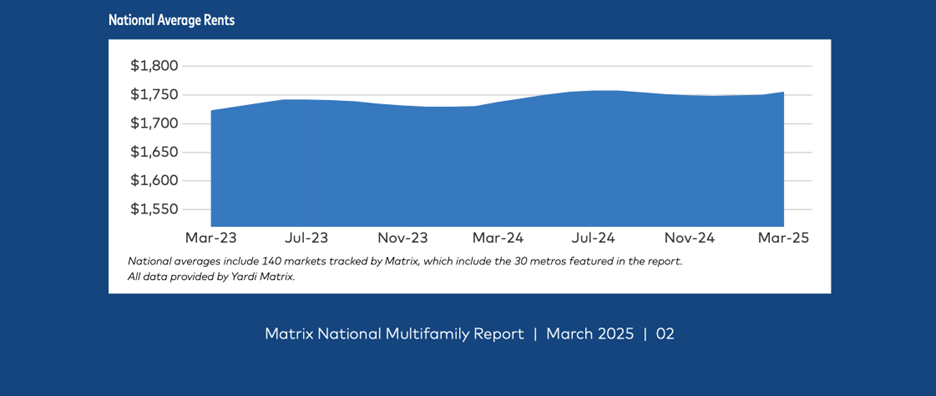
If you would like to learn more about REITs and Syndications or are interested in Ashcroft Capital’s current offerings, schedule a call with Investor Relations today.

lennon@ashcroftcapital.com

Back to News Page

Creating Your Own Economy: Focus on What is in Your Control

April 4, 2024

By: Travis Watts, Director of Investor Development

Three Practical Steps to Shape Your Own Economy: 

  1. Market Opportunities: Market shifts, such as fluctuations in interest rates, present opportunities for savvy investors. For instance, the recent rise in interest rates has led to a decline in commercial real estate prices, offering an opportunity to capitalize and “buy-the-dip.” At least for those willing to take action. 
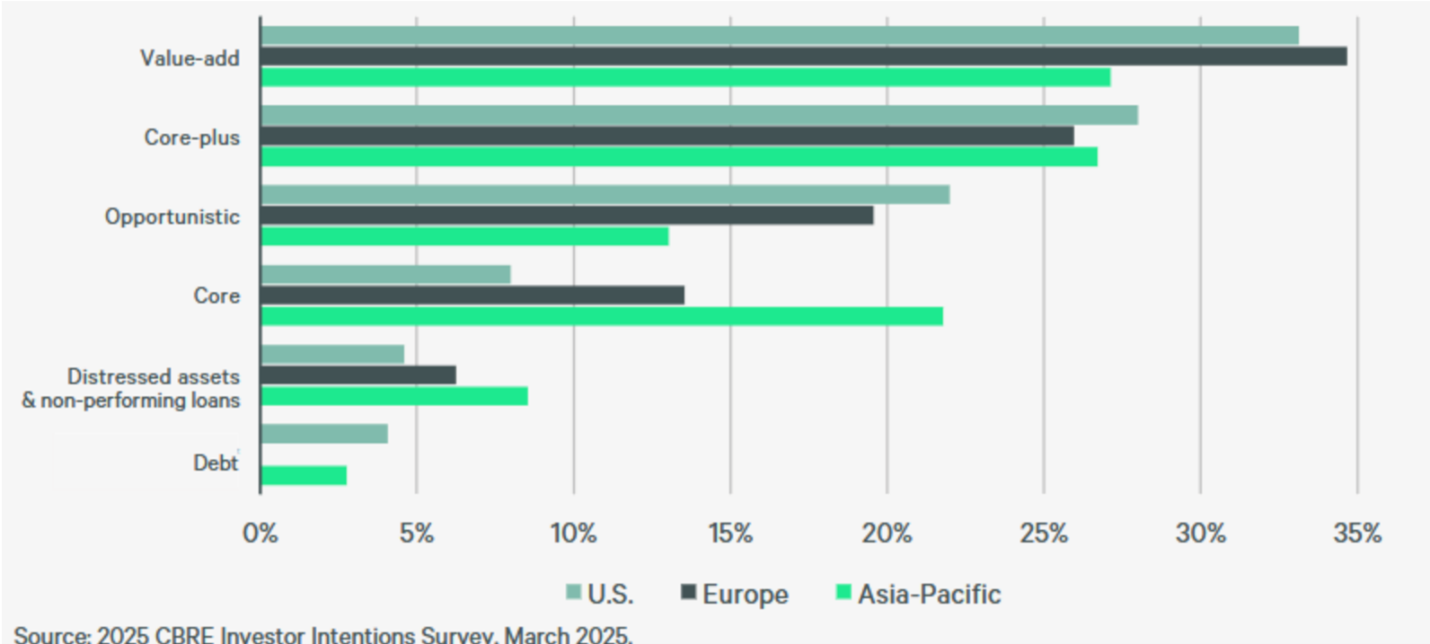
  2. Short-Term Spending: Wage increases, and high inflation have no doubt impacted consumer prices. Take for example restaurants increasing their prices. While this may be the case, the reality is we can adjust our spending habits – opting to dine out less frequently or cooking at home – we can mitigate the effects of this inflation on our personal budget. It is simply a choice. 

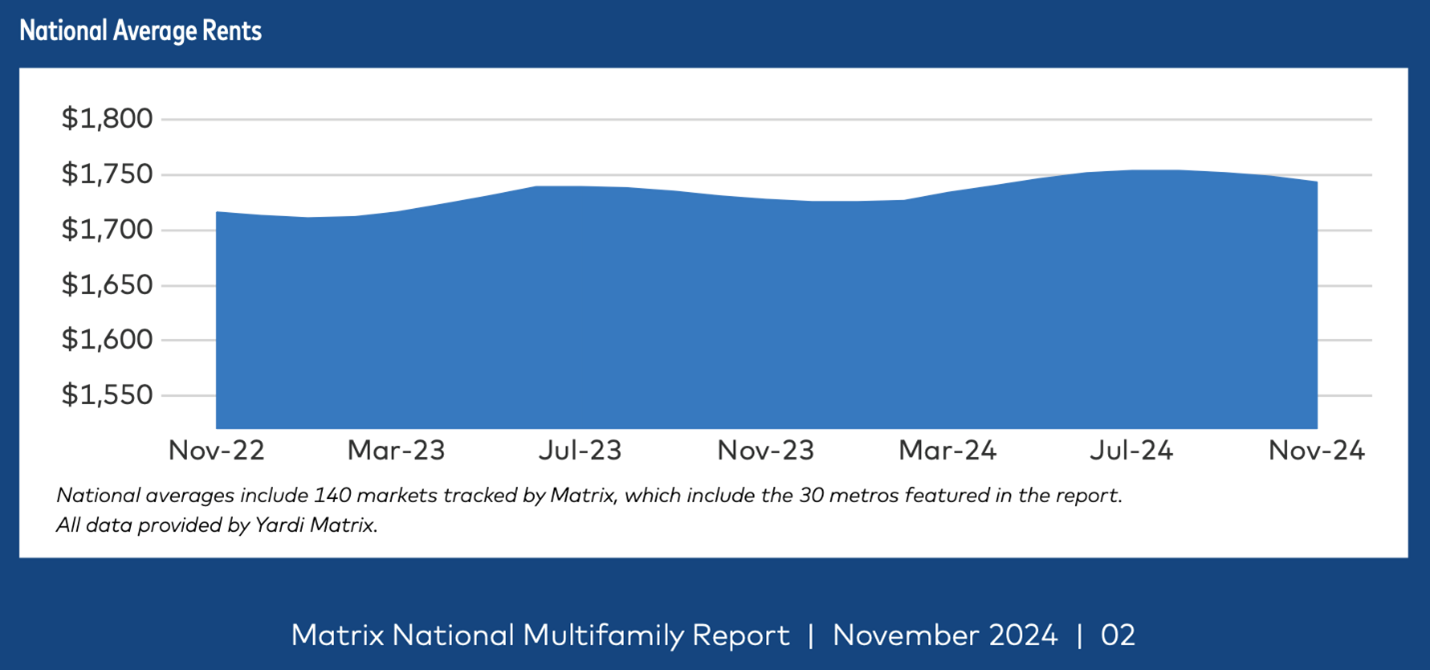
  3. Long-Term Savings: Rising fuel prices might prompt consideration of alternative transportation options, such as electric vehicles. Likewise, escalating electricity costs could incentivize investment in renewable energy sources like solar panels. These cost savings can continue for years to come. 


Multifamily Investments Beyond the Headlines 

In a world inundated with ads, opinions, and fear-based headlines, it can be useful to take a step back and consider our own individual reality from time to time.   

I recently had an epiphany during a conversation with an investor as we discussed the multifamily real estate sector. The classic question arose, “Is now a good time to invest in multifamily?” His concern was prompted by a news report he had read. The report suggested that apartment rents could soften in 2024.  

Reflecting upon this information, I could not help but consider the multifamily investments I have made over the past year. In the deals I have been involved in, the rents are steadily on the rise; many of them are on track to achieve a 5-10% rent increase by the end of the year.  

This reflects investing in value-add business plans where an older property is purchased at a discount because it needs renovation and has below market rents in place due to its outdated condition. The business plan is simply to renovate and improve the property, while increasing the rents back to the market level.  

So, the disparity between “rents declining” according to a news report and “rents increasing” according to my actual portfolio, underscored a fundamental truth: our perspectives shape our reality. 


Scenarios to Consider:

#1 If a news report stated the national median household income was $75,000, but your personal income was $150,000, the report would hold little relevance, because your personal economy is what matters to you.  

#2 If a news headline stated “US inflation peaked out around 9% in 2022, Americans are now scrambling” the reality is your individual inflation rate could have varied significantly based on your specific circumstances that year. For example, if you chose to cut your expenses by 9% in 2022, you might have experienced minimal inflation impact, even none at all.  


Building Your Financial Future Beyond Media Narratives  

The point is: you are the architect of your own reality. It is not dictated by headlines, news, or media narratives – it is determined by your choices, and actions. 

We control our own economy, and we can steer our financial future toward success, despite what is on the news or in the media. With uncertainty and economic volatility, opportunities are reserved for those willing to act. By remaining adaptable during market shifts, we can navigate the ever-changing economic landscape with confidence and resilience. 

Want to learn more about multifamily investment or our current offerings? We welcome you to schedule a call with our investor relations team today.

travis@ashcroftcapital.com


Back to News Page

Beyond Retirement: From Air Force Wings to Real Estate Roots

April 2, 2024

Investor Feature - Real Estate Retirement - Jim Cummings

“One of my biggest realizations was that no matter what business you’re in, you’re actually in business for yourself.” 


Refusing to Retire 

Air Force veteran, and still-active real estate broker, Jim Cummings is celebrating his 81st birthday this year. He has devoted his career and a large portion of his investment portfolio to real estate––and he’s still not in the mood to retire.  

“I got licensed in 1988, progressed through being an agent, then a broker, and eventually went out on my own,” says Jim, summarizing his long and successful career. Along the way, he’s amassed a great deal of wisdom (and property), and his investment journey is a classic study in transitioning from single-family property management to real estate investing.   

Jim Cummings - Air Force


Getting the Hang of Real Estate 

“In a military career, you move every few years, and you become familiar with buying and selling houses,” explains Jim. “So, that sparked an interest in real estate. I actually got a license before I left the service. When I retired from the Air Force, the economy was not good, but a friend of mine I’d been stationed with before was an agent, and I just decided that if I’m going to do it, now is the time to take the plunge.”  

It was the bottom of the dotcom bust, but more experienced colleagues encouraged Jim that he would do well as soon as the market recovered. “I just kind of persevered. Fortunately, my wife was working, and I was bringing enough money from the military that we could keep food on the table, the lights turned on, and the rent paid. As the market turned up, those first few years were probably the hardest I’ve ever worked in any job––and I’ve worked in an oil field.” 

Jim recalls learning how to work “smarter, not harder” in those early years. “You learn what you have to do and what you need to make happen,” he says. And he was helped along by the advice of a trusted mentor:

“It doesn’t matter if you go with a big company, a small company, or a medium sized company. It’s all up to you. You either make it yourself or you don’t make it.”  

 

Learning to Make Smart Real Estate Investments 

Luckily Jim was a quick learner––and determined to find success in his career as well as his investment strategy. But it wasn’t without trial and error. “While I was still in the Air Force at the last duty station, I bought a vacant lot with the idea that if I end up staying, I’m going to build a triplex. It was in a relatively renewed duplex community that was within a mile or so of where we lived at that point. When we decided we weren’t going to stay there, I just put up a sign and made a few thousand dollars on it.” 

Around the same time, Jim acquired two rental properties in Austin, Texas. “Market timing was not good––I lost my shirt on both of them!” he laments in good humor. “When I moved back to Austin, I basically ended up giving them both away to get out from under the expense of it.” 

With his investment feet now firmly underneath him, it was smooth sailing into the future for Jim and his family. “I bought a foreclosure, which we moved into, but it wasn’t in great shape,” Jim explains. “There was actually a lot in the same neighborhood that I ended up buying myself with the idea that I’d build a house on it and resell it. But once we got the house built, we decided to move into the new house and keep the old one for rental property. That’s really where the investment started.” 

“I always could see the potential for real estate. It’s a good way to make use of other people’s money, and over time you can grow yourself a real estate business.” 

Jim was able to quickly pay off the note for his first home using rental income, and even remodeled it before selling when he moved the family to College Station. “I made a pretty good pile of money on it, so I took the proceeds from the sale and ended up putting down the minimum required on one new property, and then put all the rest into another one.” 

This became Jim’s preferred real estate investment strategy. He’s since added two additional properties, with the eventual goal of up to eight. “Interest rates have kind of taken me out of meeting my income goals on properties at this point in time, so that’s where I am now. I have four investment properties of my own. One will be paid off in June, and the others are cash flowing pretty well.”  

Additionally, Jim still manages three properties for his clients, down from a hefty load of 25 under his purview in the past. And the result of all this experience in the industry? “I’ve been bloodied a little bit, so I have a pretty good feel for what makes real estate profitable or not,” he says.  

Jim Cummings - Kids


Letting Ashcroft Capital Do the Heavy Lifting 

Jim is a self-described “recovering workaholic” and doesn’t plan to ever fully retire, but he recently found himself needing to offload some of the labor of single-family property management. That’s when he turned to Ashcroft to facilitate a more passive income investing strategy. “I’ve reached the point that I’m getting too old to continue pursuing more single-family properties. And with the market the way it is, I just want to put my money to work.”  

After hearing about Ashcroft on BiggerPockets, Jim was inspired to connect with the team.

“With the interest rate staying up there and some money on hand, I just said, ‘Now’s the time to take the plunge.’ So, we took off a small chunk and invested with Ashcroft just to see how well it worked. I was looking to get more return than CDs, which at that point were doing little or nothing. The fact that I could expect a 13-14%, maybe even up to 20%, total return on the investment was attractive to me.”  

However, for Jim, money is just the byproduct of good decisions and good intentions––and we couldn’t agree more. His philosophy is, “Take care of the customer; the money will take care of itself. They’re paying good hard-earned money, and they deserve a great place to live. That’s what you’re there to provide, and ideally, you’re making a profit in the end.”  

Jim is just one of our 3,000+ investors. Hear what passive income has meant to over 100 of our investors.